


Page 118 - Separation process principles 2
P. 118
3.2  Diffusion Coefficients  83


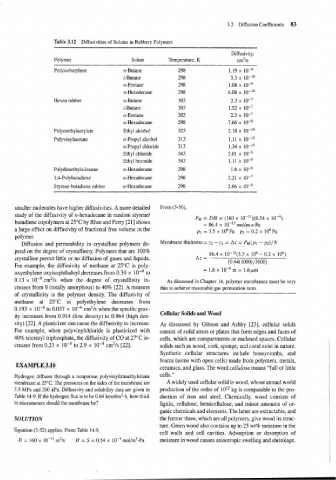
                    Table 3.12  Diffusivities of  Solutes in Rubbery Polymers
                                                                                   Diffusivity,
                    Polymer                     Solute       Temperature, K          cm2/s
                    Polyisobutylene          n-Butane
                                             i-Butane
                                             n-Pentane
                                             n-Hexadecane
                    Hevea rubber             n-Butane
                                             i-Butane
                                             n-Pentane
                                             n-Hexadecane
                    Polymethylacrylate       Ethyl alcohol
                    Polyvinylacetate         n-Propyl alcohol
                                             n-Propyl chloride
                                             Ethyl chloride
                                             Ethyl bromide
                    Polydimethylsiloxane     n-Hexadecane
                     1,4-Polybutadiene       n-Hexadecane
                    Styrene-butadiene rubber   n-Hexadecane


       smaller molecules have higher diffusivities. A more detailed   From (3-50),
       study of the diffusivity of n-hexadecane in random styrene1
       butadiene copolymers at 25°C by Rhee and Ferry [21] shows
       a large effect on diffusivity of fractional free volume in the
      polymer.
         Diffusion and permeability in crystalline polymers de-   Membrane thickness = 22  - zl  = Az  = P~(pi - p2)IN
      pend on the degree of crystallinity. Polymers that are 100%
      crystalline permit little or no diffusion of gases and liquids.
      For example, the diffusivity of  methane at 25OC  in  poly-
      oxyethylene oxyisophthaloyl decreases from 0.30 x  low9 to
      0.13 x  lop9 cm2/s  when  the  degree  of  crystallinity  in-   As discussed in Chapter 14, polymer membranes must be very
      creases from 0 (totally amorphous) to 40% [22]. A measure   thin to achieve reasonable gas permeation rates.
      of  crystallinity is  the  polymer density. The diffusivity of
      methane  at  25°C  in  polyethylene  decreases  from
      0.193 x     to 0.057 x   cm2/s when the specific grav-
                                                          Cellular Solids and Wood
      ity increases from 0.914 (low density) to 0.964 (high den-
      sity) [22]. A plasticizer can cause the diffusivity to increase.   As  discussed  by  Gibson  and Ashby  [23], cellular  solids
      For  example,  when  polyvinylchloride is  plasticized  with   consist of solid struts or plates that form edges and faces of
      40% tricresyl triphosphate, the diffusivity of CO at 27°C in-   cells, which are compartments or enclosed spaces. Cellular
      creases from 0.23 x   to 2.9 x  lop8 cm2/s [22].    solids such as wood, cork, sponge, and coral exist in nature.
                                                          Synthetic  cellular  structures  include  honeycombs,  and
                                                          foams (some with open cells) made from polymers, metals,
       EXAMPLE 3.10
                                                          ceramics, and glass. The word cellulose means "full of little
      Hydrogen diffuses through a nonporous polyvinyltrimethylsilane   cells."
      membrane at 25OC. The pressures on the sides of the membrane are   A widely used cellular solid is wood, whose annual world
      3.5 MPa and 200 kPa. Diffusivity and solubility data are given in   production of the order of  1012 kg is comparable to the pro-
      Table 14.9.  If the hydrogen flux is to be 0.64 kmol/m2-h, how thick   duction  of  iron  and  steel.  Chemically, wood  consists  of
      in micrometers should the membrane be?              lignin, cellulose, hemicellulose, and minor amounts of  or-
                                                          ganic chemicals and elements. The latter are extractable, and
      SOLUTION                                            the former three, which are all polymers, give wood its struc-
                                                          ture. Green wood also contains up to 25 wt% moisture in the
      Equation (3-52) applies. From Table 14.9,
                                                          cell  walls  and  cell  cavities. Adsorption  or  desorption  of
        D=160~10-~~m~/s H=S=0.54~10-~mol/m~-~a  moisture in wood causes anisotropic swelling and shrinkage.

