


Page 121 - Separation process principles 2
P. 121
86  Chapter 3  Mass Transfer and Diffusion


                                                                    Thus, using the Leibnitz rule for differentiating the integral
                                                                    of (3-76), with x  = z/247a,


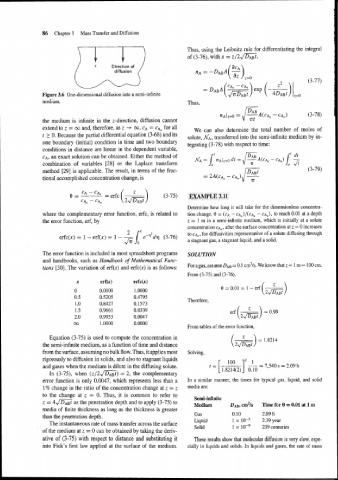
                 Figure 3.6  One-dimensional diffusion into a semi-infinite
                 medium.                                            Thus.


                 the medium is infinite in  the z-direction, diffusion cannot
                 extend to z  = oo and, therefore, as z -+ oo, CA = CA~ for all   We  can  also  determine the  total  number  of  moles  of
                 t >_  0. Because the partial differential equation (3-68) and its
                                                                    solute, NA, transferred into the semi-infinite medium by in-
                 one boundary (initial) condition in time and two boundary
                                                                    tegrating (3-78) with respect to time:
                 conditions in distance are linear in the dependent variable,
                 CA, an exact solution can be obtained. Either the method of
                 combination  of  variables  [28]  or  the  Laplace  transform
                 method [29] is applicable. The result, in terms of  the frac-
                 tional accomplished concentration change, is


                                                                    Determine how long it will take for the dimensionless concentra-
                 where the complementary error function, erfc, is related to   tion change, 0 = (cA - cpb)/(cA, - cA,), to reach 0.01 at a depth
                 the error function, erf, by                        z = 1 m in a semi-infinite medium, which is initially at a solute
                                                                    concentration CA,, after the surface concentration at z = 0 increases
                                                                    to CA, , for diffusivities representative of  a solute diffusing through
                                                                    a stagnant gas, a stagnant liquid, and a solid.

                 The error function is included in most spreadsheet programs   SOLUTION
                 and handbooks, such as Handbook  of Mathematical  Func-
                                                                    For agas, assume DAB = 0.1 cm2/s. We know that z = 1 m = 100 cm.
                 tions [30]. The variation of erf(x) and erfc(x) is as follows:
                                                                    From (3-75) and (3-76),

                                                                                0 = 0.01 = 1 - erf  -
                                                                                              (2&)
                                                                    Therefore,


                                                                    From tables of the error function,
                   Equation (3-75) is used to compute the concentration in
                 the semi-infinite medium, as a function of time and distance
                 fromthe surface, assuming no bulk flow. Thus, it applies most   Solving,
                 rigorously to diffusion in solids, and also to stagnant liquids
                 and gases when the medium is dilute in the diffusing solute.
                   In  (3-73, when  (z/247a) = 2, the  complementary
                 error function is only 0.0047, which represents less than a   In  a similar manner, the  times for  typical gas, liquid, and  solid
                 1% change in the ratio of the concentration change at z = z   media are:
                 to  the  change  at  z = 0. Thus,  it  is  common  to  refer  to
                                                                      Semi-infinite
                 z = 4    m  as the penetration depth and to apply (3-75) to   Medium   DAB, cm2/s   Time for 0 = 0.01 at 1 m
                 media of finite thickness as long as the thickness is greater
                                                                      Gas           0.10       2.09 h
                 than the penetration depth.
                                                                      Liquid        1 x        2.39 year
                   The instantaneous rate of mass transfer across the surface   Solid          239 centuries
                 of the medium at z = 0 can be obtained by taking the deriv-        1 x
                 ative of  (3-75) with respect to distance and substituting it   These results show that molecular diffdsion is very slow, espe-
                 into Fick's  first law  applied at the surface of the medium.   cially in liquids and solids. In liquids and  gases, the rate of  mass

