


Page 125 - Separation process principles 2
P. 125
90  Chapter 3  Mass Transfer and Diffusion


                 3.4  MOLECULAR DIFFUSION                           Thus, the maximum liquid velocity, which occurs at z = 0, is
                 IN LAMINAR FLOW
                 Many mass-transfer operations involve diffusion in fluids in
                 laminar flow. The fluid may be a film flowing slowly down a
                                                                    The bulk-average velocity in the liquid film is
                 vertical or inclined surface, a laminar boundary  layer that
                 forms as the fluid flows slowly past a thin plate, or the fluid
                 may flow through a small tube or slowly through a large pipe
                 or duct. Mass transfer may occur between a gas and a liquid   Thus, the film thickness for fully developed flow is indepen-
                 film, between a solid surface and a fluid, or between a fluid
                                                                    dent of location y and is
                 and a membrane surface.

                 Falling Liquid Film
                                                                    where r = liquid film flow rate per unit width of film, W.
                 Consider a thin liquid film, of  a mixture of  volatile A and
                                                                      For film flow, the Reynolds number, which is the ratio of
                 nonvolatile B, falling in laminar flow at steady state down
                                                                    the inertial force to the viscous force, is
                 one side of a vertical surface and exposed to pure gas, A, on
                 the other side of the film, as shown in Figure 3.12. The sur-
                face is infinitely wide in the x-direction (normal to the page).
                 In the absence of mass transfer of A into the liquid film, the
                                                                    where r~ = hydraulic radius = (flow cross section)/(wetted
                 liquid velocity in the z-direction, u,,  is zero. In the absence of
                                                                    perimeter) = (W6)l W = 6 and, by the equation of continu-
                 end effects, the equation of motion for the liquid film in fully
                                                                    ity,r =iyp6.
                 developed laminar flow in the downward y-direction is
                                                                      As reported by Grimley [32], for NR, < 8 to 25, depend-
                                                                    ing on the surface tension and viscosity, the flow in the film
                                                                    is laminar and the interface between the liquid film and the
                                                                    gas is flat. The value of 25 is obtained with water. For 8 to
                                                                    25 < NRe < 1,200, the flow is still laminar, but ripples and
                Usually, fully developed flow, where uy is independent of the
                                                                    waves may appear at the interface unless suppressed by the
                distance y, is established quickly. If 6 is the thickness of the
                                                                    addition of wetting agents to the liquid.
                film and the boundary conditions are uy = 0 at z = 6 (no-
                                                                      For a flat liquid-gas  interface and a small rate of  mass
                slip condition at the solid surface) and duy/dz = 0 at z = 0
                                                                    transfer of A into the liquid film, (3-88) to (3-93) hold and
                (no drag at the liquid-gas  interface), (3-88) is readily inte-
                                                                    the film velocity profile is given by (3-89). Now consider a
                grated to give a parabolic velocity profile:
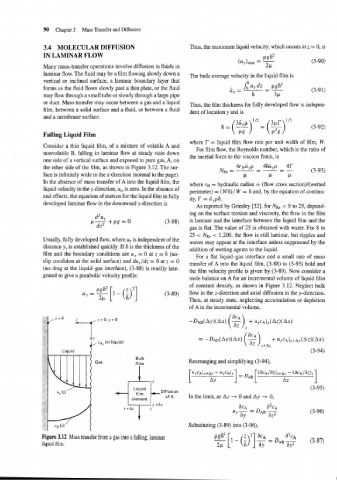
                                                                    mole balance on A for an incremental volume of liquid film
                                                                    of  constant density, as shown in Figure 3.12. Neglect bulk
                                                                    flow in the z-direction and axial diffusion in the y-direction.
                                                                    Then, at steady state, neglecting accumulation or depletion
                                                                    of A in the incremental volume,


                                                                    Rearranging and simplifying (3-94),


                                                                                                               (3-95)
                                                                    In the limit, as Az -+ 0 and Ay  -+ 0,


                                                                    Substituting (3-89) into (3-96),

                Pigure 3.12  Mass transfer from a gas into a falling, laminar
                liquid film.

