


Page 128 - Separation process principles 2
P. 128
3.4  Molecular Diffusion in Laminar Flow  93

       general solution for intermediate values of 7 is not available   Thus,
       in closed form. Similar limiting solutions for large and small
       values  of  appropriate  parameters,  usually  dimensionless
       groups, have been obtained for a large variety of transport
       and  kinetic  phenomena,  as  discussed  by  Churchill  [35].   Solving for FA,,
       Often the two limiting cases can be patched together to pro-               - -
                                                            FAL  = CA, - (CA, - cb) exp  (  ;;;)
       vide a reasonable estimate of the intermediate solution, if a
       single intermediate value is available from experiment or the
       general numerical solution. The procedure is discussed by
       Churchill and Usagi [361. The general solution of Emmert
       and Pigford [37] to the falling, laminar liquid film problem is
       included in Figure 3.13.


                                                          Thus, the exiting liquid film is saturated with C02, which implies
       EXAMPLE 3.13                                       equilibrium at the gas-liquid  interface. From (3-103),
      Water (B) at 25OC, in contact with pure C02 (A) at 1 atm, flows as
                                                           nA  = 0.0486(1.15 X  10-'l(3.4  X   = 1.9 x  low7 kmous
       a film down a vertical wall  1 m wide and 3 m high at a Reynolds
      number of 25. Using the following properties, estimate the rate of
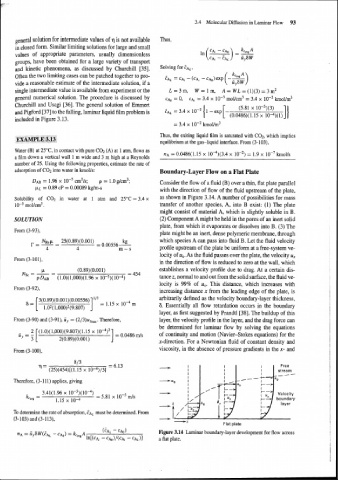
      adsorption of COz into water in kmol/s:             Boundary-Layer Flow on a Flat Plate

                                                          Consider the flow of a fluid (B) over a thin, flat plate parallel
                                                          with the direction of flow of the fluid upstream of the plate,
      Solubility  of  C02  in  water  at  1  atm  and  25°C = 3.4 x   as shown in Figure 3.14. A number of possibilities for mass
          mol/cm3.                                        transfer of  another species, A,  into B  exist: (1) The plate
                                                          might consist of  material A, which is slightly soluble in B.
      SOLUTION                                            (2) Component A might be held in the pores of an inert solid
                                                          plate, from which it evaporates or dissolves into B. (3) The
      From (3-93),
                                                          plate might be an inert, dense polymeric membrane, through
                NRe~ 25(0.89)(0.001)
            r=--     -             = 0.00556-   kg        which species A can pass into fluid B. Let the fluid velocity
                  4         4              m-s            profile upstream of the plate be uniform at a free-system ve-
                                                          locity of u,.  As the fluid passes over the plate, the velocity ux
      From (3-101),
                                                          in the direction of flow is reduced to zero at the wall, which
                                                          establishes a velocity profile due to drag. At  a certain dis-
                                                          tance z, normal to and out from the solid surface, the fluid ve-
                                                          locity  is  99%  of  u,.  This  distance, which  increases  with
      From (3-92),
                                                          increasing distance x from the leading edge of the plate, is
                                                          arbitrarily defined as the velocity boundary-layer thickness,
                                                          6.  Essentially all  flow  retardation occurs in  the boundary
                                                          layer, as first suggested by Prandtl [38]. The buildup of this
      From (3-90) and (3-91), iiy = (2/3)uy,,,  . Therefore,   layer, the velocity profile in the layer, and the drag force can
                                                         be  determined for  laminar  flow  by  solving the  equations
        -   2  (1.0)(1,000)(9.807)(1.15 x
            3 [
        Uy  = -       2(0.89)(0.001)  1   = 0.0486 mls    of continuity and motion (Navier-Stokes  equations) for the
                                                         x-direction. For a Newtonian fluid of  constant density and
                                                          viscosity, in the absence of pressure gradients in the x-  and
      From (3- 1 OO),
                                                          -
                                                                                                     Free
                                                                    I
                                                                    I           I  I         I  I   stream
                                                                    I           I            I   __----
                                                                    I           I
      Therefore, (3-1 11) applies, giving                 -u0       I           1  ..-   /---     uo
                                                          -         I  I             Uo      t- ->
                                                                                             I
                                                                                             I
                3.41(1.96 x  10-~)(10-')                            I
           kcavg =                 = 5.81 x  lop5 mls
                     1.15 x  lo-'
      To determine the rate of absorption, FA, must be determined. From
      (3-103) and (3-113),                                                      -   -  - -  - - -.
                                                               -x
                                                                                Flat plate
                                      (CAL - CA~
       n~ = Uy6W(FAL - c&) = kcWgA                       Figure 3.14  Laminar boundary-layer development for flow across
                                ln[(c~, - CA~)/(CA, CAL )I   a flat plate.
                                              -

