


Page 130 - Separation process principles 2
P. 130
3.4  Molecular Diffusion in Laminar Flow  95


       Assume the following values for physical properties:   build up as shown at planes b, c, and d. In this region, the
                                                          central core outside the boundary  layer has  a  flat velocity
       Vapor pressure of napthalene = 10 torr
       Viscosity of air = 0.0215 cP                       profile  where the flow is accelerated over the entrance ve-
       Molar density of air = 0.0327 kmol/m3              locity. Finally, at plane e, the boundary layer fills the tube.
       Diffusivity of napthalene in air = 0.94 x   m2/s   From here the velocity profile is fixed and the flow is said to
                                                          be fully developed. The distance from the plane a to plane e
       SOLUTION                                           is the entry region.
                                                             For fully  developed laminar flow in  a straight, circular
       (a) NRe,  = 5 x  lo5 for transition. From (3-127),   tube, by experiment, the Reynolds number, NRe = Dii, p /p,
                                                          where ii,  is the flow-average velocity in the axial direction,
                                                          x, and D is the inside diameter of the tube, must be less than
                                                          2,100. For this condition, the equation of motion in the axial
       at which transition to turbulent flow begins.
                                                          direction for horizontal flow and constant properties is
                      10(0'0327) = 4.3  10-4  hoyrn3
       (b) CA~ = 0   CA,  =
                         760
       From (3-lol),
                                                          where the boundary conditions are
                  P        [(0.0215)(0.001)]
                     -
                     -
           Nsc = -                           = 2.41                r  = 0 (axis of the tube),  au,/ar  = 0
                pDAB  [(0.0327)(29)](0.94 x
                                                          and      r  = r,(tube  wall),  u, = 0
       From (3- 137),
                                                          Equation  (3-139)  was  integrated  by  Hagen  in  1839  and
               Nshavg  = 0.664(5 x  10~)~/~(2.41)~/~ = 630
                                                          Poiseuille in  1841. The resulting equation for the velocity
       From (3-138),                                      profile, expressed in terms of  the flow-average  velocity, is


       For a width of 1 m,
                                                          or, in terms of the maximum velocity at the tube axis,
          A = 2.27 m2


       (c)  From (3-129), at x = L = 2.27 m,              From the form of (3-141), the velocity profile is parabolic in
                                                          nature.
                                                             The shear stress, pressure drop, and Fanning friction fac-
                                                          tor are obtained from solutions to (3-139):
       From (3-135),


                                                                    dP    32pii,   2 fpii:
       Fully Developed Flow in a Straight, Circular Tube                -       -                   (3-143)
                                                                    dx     D2       D
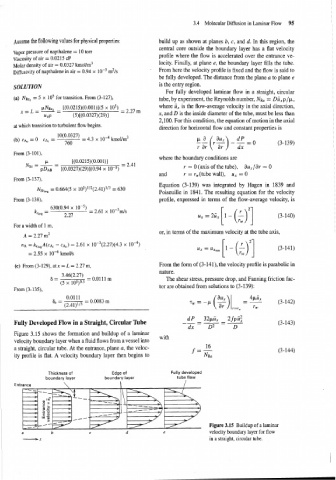
       Figure 3.15 shows the formation and buildup  of  a laminar
                                                          with
       velocity boundary layer when a fluid flows from a vessel into
       a straight, circular tube. At the entrance, plane a, the veloc-   f=- 16
       ity profile is flat. A velocity  boundary  layer then begins to    NR~


                   Thickness of          Edge of              Fully developed
                  boundary layer       boundary layer           tube flow
       Entr


                                                                            Figure 3.15  Buildup of a laminar
         u          b            c            d             e               velocity boundary layer for flow
          -X                                                                in a straight, circular tube.

