


Page 135 - Separation process principles 2
P. 135
100  Chapter 3  Mass Transfer and Diffusion


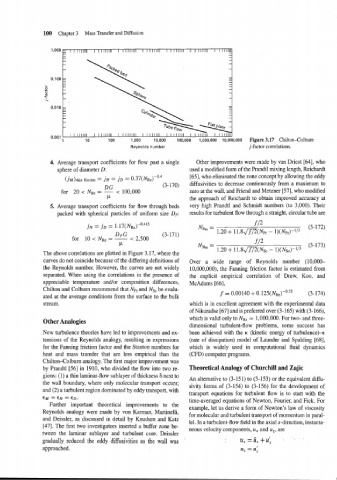
                                                                                         Figure 3.17  Chilton-Colburn
                                               Reynolds number                           j-factor correlations.

                   4.  Average transport coefficients for flow past a single   Other improvements were made by van Driest [64], who
                     sphere of diameter D:                          used a modified form of the Prandtl mixing length, Reichardt
                                                                    [65], who eliminated the zone concept by allowing the eddy
                        (j~)skin friction  = j~ = j~ = O.~~(NR~)-O.~
                                                                    diffusivities to decrease continuously from a maximum to
                                      DG                   (3-170)
                       for  20 < NRe = - < 100,000                  zero at the wall, and Friend and Metzner [57], who modified
                                       P                            the approach of  Reichardt to obtain improved accuracy at
                   5.  Average transport coefficients for flow through beds   very  high Prandtl and  Schmidt numbers  (to 3,000). Their
                     packed with spherical particles of  uniform  size Dp:   results for turbulent flow through a straight, circular tube are
                                                  -0.415
                                jH = jD = 1.17(NRe)                                        f 12               (3-172)
                                                                       N~tH =
                                                           (3-171)            1.20 + 1 1.8m(Np, - l)(Npr)-'I3
                           for  10<NRe=- DPG < 2,500
                                           P                           N~tM =              f 12               (3-173)
                                                                              1.20 + 1 1.8m(Nsc - l)(Nsc)-'I3
                 The above correlations are plotted in Figure 3.17, where the
                 curves do not coincide because of the differing definitions of   Over  a  wide  range  of  Reynolds  number  (10,000-
                 the Reynolds  umber. However, the curves are not widely   10,000,000), the Fanning friction factor is estimated from
                 separated. When  using the correlations in the presence of   the  explicit  empirical  correlation  of  Drew,  Koo,  and
                 appreciable  temperature  and/or  composition  differences,   McAdams [66],
                Chilton and Colburn recommend that Np, and Ns,  be evalu-
                                                                                                              (3-174)
                                                                               f = 0.00140 + 0.125(~~~)-"~~
                 ated at the average conditions from the surface to the bulk
                 stream.                                            which is in excellent agreement with the experimental data
                                                                    of Nikuradse [67] and is preferred over (3-165) with (3- 166),
                                                                    which is valid only to NRe = 1,000,000. For two- and three-
                Other Analogies
                                                                    dimensional  turbulent-flow  problems,  some  success  has
                New turbulence theories have led to improvements and ex-   been  achieved with the  K  (kinetic energy of  turbulence)+
                tensions of  the Reynolds analogy, resulting in expressions   (rate of  dissipation) model of Launder and Spalding [68],
                for the Fanning friction factor and the Stanton numbers for   which  is  widely  used  in  computational  fluid  dynamics
                heat  and  mass  transfer  that  are  less  empirical  than  the   (CFD) computer programs.
                Chilton-Colburn  analogy. The first major improvement was
                by Prandtl [56] in 1910, who divided the flow into two re-   Theoretical Analogy of Churchill and Zajic
                gions: (1) a thin laminar-flow sublayer  thickness  next to
                                                                    An alternative to (3-151) to (3-153) or the equivalent diffu-
                the wall boundary, where                   Occurs;   sivity forms of (3-154) to  (3-156) for the development of
                and (2) aturbulent region                    with
                                                                    trans~ort eauations for turbulent flow is to  start  with the
                EM  =EH  =ED.
                                                                    time-averaged equations of Newton, Fourier, and Fick. For
                                                           to  the
                                                                    example, let us derive a form of Newton's law of viscosity
                                were made by  'On       Manine11i9   for molecular and turbulent transport of momentum in paral-
                and Deissler, as discussed in   by  'Iludsen   and  Katz   lel. In a turbulent-flow field in the axial >direction,  instanta-
                [47]. The first two investigators inserted a buffer zone be-
                                                                    neous velocity components, ux and uz, are
                tween  the  laminar  sublaver  and  turbulent  core.  Deissler
                gradually reduced  the  eddy  diffusivities  as  the  wall  was       uX=Ux+u~       ,   ,   .
                approached.
                                                                                      U, = U:

