


Page 136 - Separation process principles 2
P. 136
3.5  Mass Transfer in Turbulent Flow  101


       where  the  "overbarred"  component  is  the  time-averaged   Equation (3-180) is a highly accurate quantitative represen-
       (mean) local velocity and the primed component is the local   tation of turbulent flow because it is based on experimental
       fluctuating component that denotes instantaneous deviation   data and numerical simulations described by  Churchill and
       from the local mean value. The mean velocity in the perpen-   Zajic [70] and in considerable detail by Churchill [7 11. From
       dicular z-direction is zero. The mean local velocity in the x-   (3-142) and  (3-143), the  shear  stress  at  the  wall,  T,,   is
       direction over a long period O of time 0 is given by   related to the Fanning friction factor by


       The time-averaged fluctuating components uk  and u:  equal
                                                           where ix is the flow-average velocity in the axial direction.
       zero.
                                                           Combining (3- 179) with (3-1 81) and performing the required
         The local instantaneous rate  of  momentum  transfer by
                                                           integrations, both numerically and analytically, lead to the
       turbulence in  the z-direction  of  x-direction turbulent mo-
                                                           following implicit equation for the Fanning friction factor as
       mentum per unit area at constant density is
                                                           a function of the Reynolds number, NR, = 2ai,p  /p:
       The  time-average of  this  turbulent momentum transfer is
       equal to the turbulent component of the shear stress, T,,,  ,


       Because the time-average of the first term is zero, (3-177)
       reduces to
                                -                         This equation is in  excellent agreement with experimental
                         Tzx, = ~(uiu:)          (3-178)
                                                          data over a Reynolds number range of 4,000-3,000,000  and
       which is referred to as a Reynolds stress. Combining (3-178)   can probably be used to a Reynolds number of 100,000,000.
       with the molecular component of momentum transfer gives   Table  3.14  presents  a  comparison of  the  Churchill-Zajic
       the turbulent-flow form of Newton's law of viscosity,   equation, (3-182), with (3-174) of Drew et al. and (3-166)
                                                          of  Chilton  and  Colburn.  Equation  (3-174) gives  satis-
                                                          factory  agreement for  Reynolds numbers from  10,000 to
                                                           10,000,000, while (3-166) is useful only from  100,000 to
       If (3-179) is compared to (3-151), it is seen that an alterna-
                                                           1,000,000.
       tive approach to turbulence is to develop a correlating equa-
                                 -                           Churchill and Zajic [70] show that if the equation for the
       tion  for  the  Reynolds  stress,  (uiu:), first  introduced  by
                                                          conservation of  energy  is time averaged, a turbulent-flow
       Churchill and Chan [73], rather than an expression for a tur-   form of Fourier's law of conduction can be obtained with the
       bulent viscosity pt . This stress, which is a complex function    -
                                                                                                       to
                                                                                                          a
                                                          fluctuation term (uLT'). Similar time averaging leads -
       of position and rate of flow, has been correlated quite accu-
                                                          turbulent-flow form of Fick's law of diffusion with (uica).
       rately for fully developed turbulent flow in a straight, circu-
                                                          To extend (3-180) and (3-182) to obtain an expression for
       lar tube by Heng, Chan, and Churchill [69]. In generalized
                                                          the Nusselt number for turbulent-flow convective heat trans-
       form, with a the radius of the tube and y  = (a - z) the dis-   fer in a straight, circular tube, Churchill and Zajic employ an
       tance from the inside wall to the center of  the tube,  their
                                                          analogy that is free of empircism, but not exact. The result
       equation is
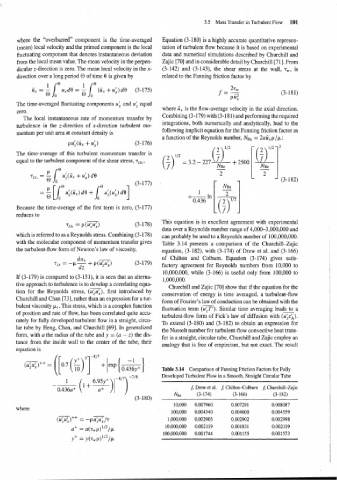
                                                          Table 3.14  Comparison of Fanning Friction Factors for Fully
                                                          Developed Turbulent Flow in a Smooth, Straight Circular Tube
                                                                     f, Drew et al.  f, Chilton-Colburn  f, Churchill-Zajic
                                                               NR~     (3-174)     (3- 166)       (3-182)

       where

