


Page 141 - Separation process principles 2
P. 141
106  Chapter 3  Mass Transfer and Diffusion

                     The instantaneous mass-transfer rate for an eddy with an   From (3-196), the residence-time distribution is given by
                  age t is given by  (3-192) for the penetration theory in flux
                  form as
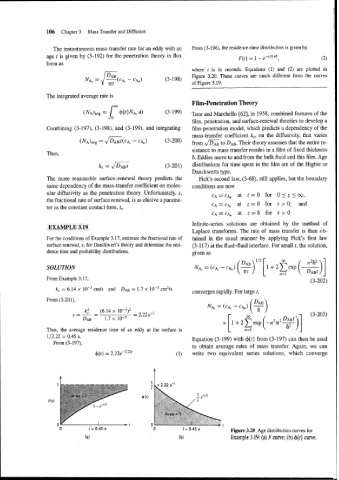
                                                                      where  t  is  in  seconds.  Equations  (1)  and  (2)  are  plotted  in
                                                                      Figure  3.20.  These  curves  are  much  different from  the  curves
                                                                      of Figure 3.19.

                  The integrated average rate is
                                                                      Film-Penetration Theory

                                                                      Toor and Marchello [62], in 1958, combined features of the
                                                                      film, penetration, and surface-renewal theories to develop a
                   Combining (3-  197), (3-198), and (3-199), and integrating:   film-penetration model, which predicts a dependency of the
                                                                      mass-transfer  coefficient kc, on the  diffusivity, that  varies
                                                                      from fi to DAB Their theory assumes that the entire re-
                                                                      sistance to mass transfer resides in a film of  fixed thickness
                  Thus,
                                                                      6. Eddies move to and from the bulk fluid and this film. Age
                                                                      distributions for time spent in the film are of  the Higbie or
                                                                      Danckwerts type.
                  The  more  reasonable  surface-renewal theory  predicts  the   Fick's second law, (3-68), still applies, but the boundary
                   same dependency of the mass-transfer coefficient on molec-   conditions are now
                  ular diffusivity as the penetration theory. Unfortunately, s,
                                                                             CA = CA~ at  t  = 0  for  0 5 z  5 GO,
                  the fractional rate of surface renewal, is as elusive a parame-
                                                                             CA = CA,  at  z  = 0  for  t > 0;  and
                  ter as the constant contact time, tc.
                                                                             CA = CA~ at  z  = 6  for  t > 0
                                                                      Infinite-series  solutions  are  obtained  by  the  method  of
                   EXAMPLE 3.19
                                                                      Laplace transforms. The rate of  mass  transfer is then  ob-
                  For the conditions of Example 3.17, estimate the fractional rate of   tained  in  the  usual  manner  by  applying  Fick's  first law
                  surface renewal, s, for Danckwert's theory and determine the resi-   (3-1 17) at the fluid-fluid  interface. For small t, the solution,
                  dence time and probability distributions.           given as


                  SOLUTION
                  From Example 3.17,

                      kc = 6.14 x  lop3 cmls  and  DAB = 1.7 x   cm2/s
                                                                      converges rapidly. For large t,
                  From (3-201),


                  Thus,  the  average residence time  of  an  eddy  at the  surface is
                   112.22 = 0.45 s.
                                                                      Equation (3-199) with +It] from (3-197) can then be used
                     From (3-197),
                                                                      to  obtain  average rates  of  mass  transfer. Again,  we  can
                                                                      write  two  equivalent  series  solutions,  which  converge


                      1

                   FIII


                      0
                       0         7 = 0.45 s
                                                                                    Figure 3.20  Age distribution curves for
                                (a)                              (b)               Example 3.19: (a) F curve: (b) $(t} curve.

