


Page 145 - Separation process principles 2
P. 145
110  Chapter 3  Mass Transfer and Diffusion


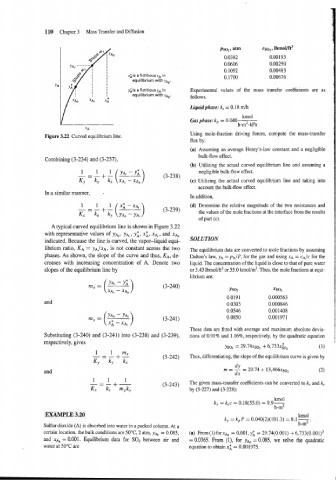
                                               xiis a fictitious xA in
                                                equilibrium with ynb

                                               yiis a fictitious yA in   Experimental  values  of  the  mass  transfer  coefficients  are  as
                                                equilibrium with xAb
                                                                     follows.
                                                                     Liquid phase:  kc = 0.18 m/h
                                                                                       kmol
                                                                     Gas phase: kp = 0.040------
                                                                                      h-m2-k~a
                                IA
                                                                     Using  mole-fraction  driving  forces,  compute  the  mass-transfer
                 Figure 3.22  Curved equilibrium line.
                                                                     flux by:
                                                                     (a) Assuming  an  average Henry's-law  constant and  a negligible
                                                                        bulk-flow effect.
                 Combining (3-234) and (3-237),
                                                                     (b)  Utilizing  the  actual curved  equilibrium  line  and  assuming  a
                                                                        negligible bulk-flow effect.
                                                                     (c) Utilizing  the  actual  curved  equilibrium  line  and  taking  into
                                                                        account the bulk-flow effect.
                 In a similar manner,
                                                                     In addition,
                                                                     (d)  Determine  the relative magnitude of  the two resistances  and
                                                                        the values of the mole fractions at the interface from the results
                                                                        of part (c).
                    A typical curved equilibrium line is shown in Figure 3.22
                 with representative values of YA~, YA, , y;,  xi;,  XA,, and XA,
                 indicated. Because the line is curved, the vapor-liquid  equi-   SOLUTION
                 librium ratio, KA = yA/xA, is not constant across the two   The equilibrium data are converted to mole fractions by assuming
                 phases. As shown, the slope of  the curve and thus, KA, de-   Dalton's  law, y~ = pA/P, for the gas and using XA = cA/c for the
                 creases  with  increasing  concentration of  A.  Denote  two   liquid. The concentration of the liquid is close to that of pure water
                 slopes of the equilibrium line by                   or 3.43 lbmol/ft3 or 55.0 kmoUm3. Thus, the mole fractions at equi-
                                                                     librium are:


                 and


                                                                     These data are fitted with average and maxinlum  absolute devia-
                 Substituting (3-240) and (3-241) into (3-238) and (3-239),   tions of 0.91% and 1.16%, respectively, by the quadratic equation
                 respectively, gives

                                                                     Thus, differentiating, the slope of the equilibrium curve is given by


                 and
                                                                     The given mass-transfer coefficients can be converted to k,  and k,
                                                                     by (3-227) and (3-228):
                                                                                                   kmol
                                                                             k,  = kCc = 0.18(55.0) = 9.9-
                                                                                                   h-m2
                  EXAMPLE 3.20                                                                             kmol
                                                                                 k,  = kp P  = 0.040(2)(101.3)  = 8.1 -
                 Sulfur dioxide (A) is absorbed into water in a packed column. At a                        h-m2 '
                 certain location, the bulk conditions are 50°C, 2 atm, y~~ = 0.085,   (a) From (1) forx~, = 0.001, yi = 29.74(0.001) + 6,733(0.001)~
                 and  XA~ = 0.001.  Equilibrium  data  for  SO2 between  air  and   = 0.0365.  From  (I),  for  y~, 0.085,  we  solve  the  quadratic
                                                                                           =
                 water at 50°C are                                  equation to obtain xi = 0.001975.

