


Page 142 - Separation process principles 2
P. 142
3.7  Two-Film Theory and Overall Mass-Transfer Coefficients  107


       at different rates. Equations (3-202) and  (3-203) become,   the Marangoni effect,  is discussed in some detail by  Bird,
                                                          Stewart, and Lightfoot [28], who cite additional references.
                                              112
           NA,~ = ~(cA, - CA,) = (CA, - CA,)(SDAB)        The effect can occur at both vapor-liquid  and liquid-liquid
                    -                        -            interfaces, with the latter receiving the most attention. By
                                                          adding surfactants, which tend  to concentrate at the inter-
                                                          face, the Marangoni effect may be reduced because of stabi-
                                                          lization of the interface, even to the extent that an interfacial
                                                          mass-transfer  resistance  may  result,  causing  the  overall
                                                          mass-transfer coefficient to be reduced. In this book, unless
                                                          otherwise indicated, the Marangoni effect will be ignored
                                                          and phase equilibrium will always be assumed at the phase
                                                          interface.


                                                          Gas-Liquid  Case
       In the limit, for a high rate of  surface renewal, sS~/DA~,
       (3-204) reduces to the surface-renewal theory, (3-200). For   Consider  the  steady-state mass  transfer  of  A  from  a  gas
       low  rates  of  renewal, (3-205) reduces to  the  film theory,   phase, across an interface, into a liquid phase. It could be
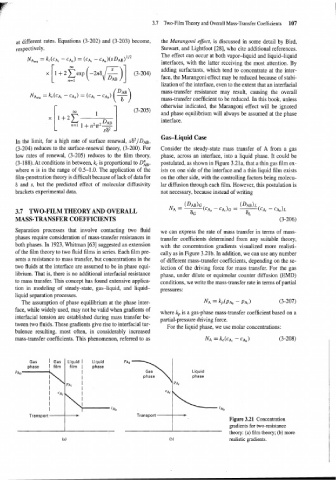
       (3- 188). At conditions in between, kc is proportional to Dig,   postulated, as shown in Figure 3.21a, that a thin gas film ex-
       where n  is in the range of  0.5-1.0.  The application of  the   ists on one side of the interface and a thin liquid film exists
       film-penetration theory is difficult because of lack of data for   on the other side, with the controlling factors being molecu-
       6  and  s, but  the  predicted effect of  molecular diffusivity   lar diffusion through each film. However, this postulation is
       brackets experimental data.                        not necessary, because instead of writing


       3.7  TWO-FILM THEORY AND OVERALL
                                                                                         -
       MASS-TRANSFER COEFFICIENTS                                                                   (3-206)
       Separation  processes  that  involve  contacting  two  fluid   we can express the rate of mass transfer in terms of  mass-
       phases require consideration of mass-transfer resistances in   transfer coefficients determined from  any  suitable theory,
       both phases. In  1923,  Whitman [63] suggested an extension   with  the  concentration gradients visualized more  realisti-
       of the film theory to two fluid films in series. Each film pre-   cally as in Figure 3.21b. In addition, we can use any number
       sents a resistance to mass transfer, but concentrations in the   of different mass-transfer coefficients, depending on the se-
       two fluids at the interface are assumed to be in phase equi-   lection of  the driving force for mass transfer. For the gas
       librium. That is, there is no additional interfacial resistance   phase, under dilute or equimolar counter diffusion (EMD)
       to mass transfer. This concept has found extensive applica-   conditions, we write the mass-transfer rate in terms of partial
       tion  in  modeling  of  steady-state,  gas-liquid,  and  liquid-   pressures:
       liquid separation processes.
         The assumption of phase equilibrium at the phase inter-
       face, while widely used, may not be valid when gradients of   where kp is a gas-phase mass-transfer coefficient based on a
       interfacial tension are established during mass transfer be-
                                                          partial-pressure driving force.
       tween two fluids. These gradients give rise to interfacial tur-
                                                            For the liquid phase, we use molar concentrations:
       bulence  resulting,  most  often,  in  considerably  increased
       mass-transfer coefficients. This phenomenon, referred to as


            Gas    1  Gas   Liquid I   Liquid
           phase   I  film   film  1   phase
       PA6                    I                                      Liquid
                              I                                      phase
                         PA,   1                               PAL
                   I          I
                   I   C~,
                   I
                   I  I                  CA6
       1- c
                                                  Transport
            Transport
                                                                                  Figure 3.21  Concentration
                                                                                  gradients for two-resistance
                                                                                  theory: (a) film theory; (b) more
                       (a)                                   (b)                  realistic gradients.

