


Page 140 - Separation process principles 2
P. 140
3.6  Models for Mass Transfer at a Fluid-Fluid  Interface  105

  [     following form of (3-79):                          Surface-Renewal Theory

                                                           The  penetration  theory  is not  satisfying  because  the  as-
                                                           sumption of a constant contact time for all eddies that tem-
                                                           porarily reside at the surface is not reasonable, especially
                                                           for  stirred  tanks,  contactors  with  random  packings,  and
                                                           bubble and spray columns where the bubbles and droplets
  [    ~hus, the penetration theory gives                  cover a wide range of sizes. In 1951, Danckwerts [60] sug-
                                                           gested  an  improvement  to  the  penetration  theory  that
                                                           involves  the  replacement  of  the  constant  eddy  contact
                                                           time with the assumption of a residence-time distribution,
                                                           wherein  the probability  of  an  eddy  at  the  surface  being
       which predicts that kc is proportional to the square root of the
                                                           replaced by  a fresh eddy is independent of the age of  the
       molecular diffusivity, which is at the lower limit of  experi-   surface eddy.
       mental data.                                          Following the  Levenspiel  [6 I] treatment  of  residence-
          The penetration theory is most useful when mass transfer
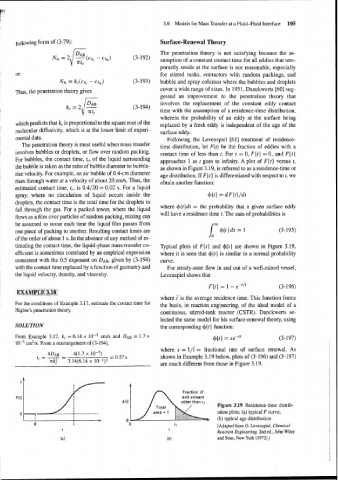
                                                           time distribution, let F(t) be  the fraction of  eddies with  a
       involves bubbles or droplets, or flow over random packing.
                                                           contact time of  less than  t. For t  = 0, F{t} = 0, and F{t)
       For bubbles, the contact time, tc, of the liquid surrounding
                                                           approaches 1 as t goes to infinity. A plot of  F(t) versus t,
       the bubble is taken as the ratio of bubble diameter to bubble-   as shown in Figure 3.19, is referred to as a residence-time or
       rise velocity. For example, an air bubble of 0.4-cm diameter
                                                           age distribution. If Fit) is differentiated with respect to t, we
       rises through water at a velocity of about 20 crnls. Thus, the   obtain another function:
       estimated contact time, tc, is 0.4/20 = 0.02 s. For a liquid
       spray,  where  no  circulation  of  liquid  occurs  inside  the
       droplets, the contact time is the total time for the droplets to
                                                           where +{t}dt = the probability that a given  surface eddy
       fall through the gas. For a packed tower, where the liquid
                                                           will have a residence time t. The sum of probabilities is
       flows as a film over particles of random packing, mixing can
       be assumed to occur each time the liquid film passes from
       one piece of packing to another. Resulting contact times are
       of the order of about 1 s. In the absence of any method of es-
       timating the contact time, the liquid-phase mass-transfer co-   Typical plots of  F(t) and +(t] are shown in Figure 3.19,
       efficient is sometimes correlated by an empirical expression   where it is seen that +It} is similar to a normal probability
       consistent with the 0.5 exponent on DAB, given by (3-194)   curve.
       with the contact time replaced by a function of geometry and   For steady-state flow in and out of a well-mixed vessel,
       the liquid velocity, density, and viscosity.        Levenspiel shows that

                                                                            F{t) = 1 - e-'li         (3-196)
                                                           where f is the average residence time. This function forms
       For the conditions of  Example 3.17, estimate the contact time for
                                                           the basis, in reaction      of the  ideal model  of a
       Higbie's penetration theory.
                                                           continuous,  stirred-tank reactor  (CSTR).  Danckwerts  se-
                                                           lected the same model for his surface-renewal theory, using
       SOLUTION                                            the corresponding +(t} function:

       From  Example  3.17, kc = 6.14 x   cm/s  and  DAB = 1.7 x             ${t) = sePSt            (3-197)
       lop5 cm2/s. From a rearrangement of  (3-194),
                                                           where  s = l/i = fractional  rate  of  surface  renewal.  As
                   4DAB     4(1.7 X
               1  C  -   -               = 0.57 s          shown in Example 3.19 below, plots of (3-196) and (3-197)
                   ~k: 3.14(6.14 x 10⁻³)2
                                                           are much different from those in Figure 3.19.

         IA


       F{t)
                                                                  older than t,
                                                         Total   . .           Figure 3.19  Residence-time distrib-
         0    1      ------+---------                   area = 1               ution plots: (a) typical F curve;
              I                      >                                         (b) typical age distribution.
                            I
              0             t                  0               f  1            [Adapted from 0. Levenspiel, Chemical
                        t                                    t
                                                                               Reaction Engineering, 2nd  ed., John Wiley
                       (a)                                   (b)               and Sons, New York (1972).]

