


Page 138 - Separation process principles 2
P. 138
3.6  Models for Mass Transfer at a Fluid-Fluid  Interface  103


       (e.g.,  constant wall temperature  and uniform heat flux)  at   Churchill-Zajic  equation:
       low-to-moderate Prandtl numbers.
                                                          Using mass-transfer analogs,
         For calculation of convective mass-transfer  coefficients,
       kc,  for  turbulent  flow  of  gases  and  liquids  in  straight,   (3-184) gives Ns,,  = 0.850
       smooth,  circular  tubes,  it  is  recommended  that  the        (3-185) gives NShl = 94
       Churchill-Zajic  equation  be  employed  by  applying  the
                                                                        (3-186) gives NSh,  = 1686
       analogy between heat and mass transfer. Thus, as illustrated
                                                                         (3-183) gives NSh = 1680
       in  the  following  example,  in  (3-183)  to  (3-186),  from
       Table 3.13, the Sherwood number, NShr is substituted for the   From Table 3.13,
       Nusselt number, NN,; and the Schmidt number, Ns,,  is sub-
       stituted for the Prandtl number, NW

                                                          which is an acceptable 92% of the experimental value.


       Linton and Sherwood [49] conducted experiments on the dissolv-
       ing  of  cast  tubes  of  cinnamic acid  (A)  into  water  (B)  flowing   3.6  MODELS FOR MASS TRANSFER AT
       through the tubes in turbulent flow. In one run, with a 5.23-cm-i.d.   A FLUID-FLUID INTERFACE
       tube, NRe = 35,800, and Ns,  = 1,450, they measured a Stanton
       number for mass transfer, NstM, of 0.000035 1. Compare this exper-   In the three previous sections, diffusion  and mass transfer
       imental value with predictions by the Reynolds, Chilton-Colburn,   within solids and fluids were considered, where the interface
       and Friend-Metzner analogies, and by the more theoretically-based   was a smooth solid surface. Of greater interest in separation
       Churchill-Zajic  equation.                         processes is mass transfer across an interface between a gas
                                                          and a liquid or between two liquid phases. Such interfaces
       SOLUTION                                           exist  in  absorption,  distillation,  extraction,  and  stripping.
                                                          At fluid-fluid  interfaces, turbulence may persist to the inter-
       From  either  (3-174) or  (3-182), the  Fanning  friction  factor  is
                                                          face.  The following  theoretical  models  have  been  devel-
       0.00576.
                                                          oped to describe mass transfer between a fluid and such an
       Reynolds analogy:                                  interface.
       From  (3-162), NstM = $ = 0.0057612 = 0.00288, which, as ex-
       pected, is in poor agreement with the experimental value because   Film Theory
       the effect of Schmidt number is ignored.
                                                          A  simple theoretical  model  for turbulent mass  transfer  to
       Chilton-Colburn  analogy:                          or from a  fluid-phase boundary was suggested  in  1904 by

       From (3-165),                                      Nernst [58], who postulated that the entire resistance to mass
                                                          transfer in a given turbulent phase is in a thin, stagnant re-
                                                          gion of that phase at the interface, called a film. This film is
                                                          similar to the laminar sublayer that forms when a fluid flows
       which is 64% of the experimental value.            in the turbulent regime parallel to a flat plate. This is shown
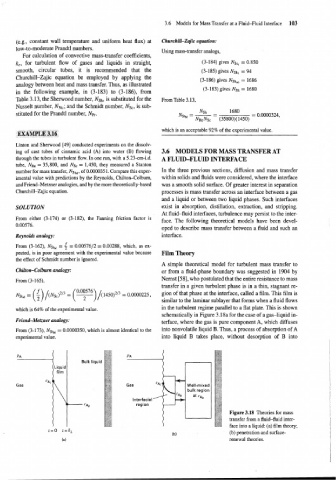
                                                          schematically in Figure 3.18a for the case of a gas-liquid  in-
       Friend-Metzner  analogy:                           terface, where the gas is pure component A, which diffuses
       From (3-173), NstM = 0.0000350, which is almost identical to the   into nonvolatile liquid B. Thus, a process of absorption of A
       experimental value.                                into  liquid  B  takes  place,  without  desorption  of  B  into


                                              Gas

                                                Interfacial
                                                 region
                                                                                  Figure 3.18  Theories for mass
                                                                                  transfer from a fluid-fluid  inter-
                                                                                  face into a liquid: (a) film theory;
                                                                                  (b) penetration and surface-        i
                                                                                  renewal theories.                   I

