


Page 137 - Separation process principles 2
P. 137
102  Chapter 3  Mass Transfer and Diffusion


                 for Prandtl numbers greater than 1 is               Chilton-Colburn  correlation, which is widely used, is within
                                                                     10% of the more theoretically  based Churchill-Zajic  equa-
                                                                     tion for Reynolds numbers up to 1,000,000. However, beyond
                                                                     that, serious deviations occur (25% at NRe = 10,000,000 and
                                                                     almost  50%  at  NRe = 100,000,000).  Deviations  of  the
                                                                     Friend-Metzner  correlation from the Churchill-Zajic  equa-
                 where, from Yu, Ozoe, and Churchill [72],           tion vary from about  15% to 30%  over the entire range of
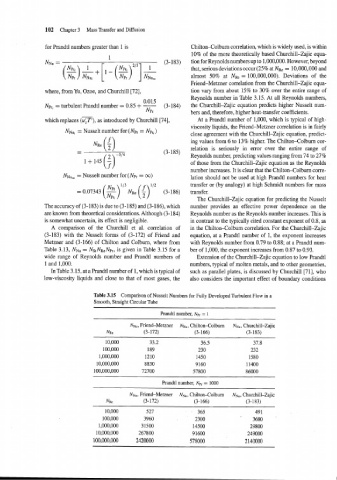
                                                                     Reynolds number  in Table 3.15. At all Reynolds numbers,
                                                    0.015
                                                           (3-184)
                 Npr, = turbulent Prandtl number = 0.85 + -          the Churchill-Zajic  equation  predicts  higher Nusselt num-
                                                     Npr             bers and, therefore, higher heat-transfer coefficients.
                              -
                 which replaces (u;T1), as introduced by Churchill 1741,   At a Prandtl number of  1,000, which is typical  of high-
                                                                     viscosity liquids, the Friend-Metzner  correlation is in fairly
                        NNu,  = Nusselt number for (Npr = Nps)
                                                                     close agreement with the Churchill-Zajic  equation, predict-
                                                                     ing values from 6 to 13% higher. The Chilton-Colburn  cor-
                                                                     relation  is  seriously  in  error  over  the  entire  range  of
                                                                     Reynolds number, predicting values ranging from 74 to 27%
                                                                     of those from the Churchill-Zajic  equation as the Reynolds
                                                                     number increases. It is clear that the Chilton-Colburn  corre-
                        NN~,                                         lation should not be used at high Prandtl numbers  for heat
                             = Nusselt number for (Npr = co)
                                                                     transfer or (by analogy) at high Schmidt numbers for mass
                                                                     transfer.
                                                                       The Churchill-Zajic  equation for predicting the Nusselt
                 The accuracy of (3-183) is due to (3-185) and (3-186), which   number  provides  an  effective  power  dependence  on  the
                 are known from theoretical considerations. Although (3-184)   Reynolds number as the Reynolds number increases. This is
                 is somewhat uncertain, its effect is negligible.    in contrast to the typically cited constant exponent of 0.8, as
                    A  comparison  of  the  Churchill  et  al.  correlation  of   in the Chilton-Colburn  correlation. For the Churchill-Zajic
                 (3-183) with  the Nusselt  forms  of  (3-172) of  Friend  and   equation, at a Prandtl number of  1, the exponent increases
                 Metzner  and (3-166) of  Chilton and Colburn, where from   with Reynolds number from 0.79 to 0.88; at a Prandtl num-
                 Table 3.13, NNu = NStNRe NPr, is given in Table 3.15 for a   ber of  1,000, the exponent increases from 0.87 to 0.93.
                 wide  range  of  Reynolds  number  and  Prandtl  numbers  of   Extension of the Churchill-Zajic  equation to low Prandtl
                 1 and 1,000.                                        numbers, typical of molten metals, and to other geometries,
                   In Table 3.15, at a Prandtl number of 1, which is typical of   such as parallel plates, is discussed by Churchill [71], who
                 low-viscosity liquids and  close  to that  of  most  gases,  the   also considers the important effect of boundary conditions


                                   Table 3.15  Comparison of Nusselt Numbers for Fully Developed Turbulent Flow in a
                                   Smooth, Straight Circular Tube

                                                          Prandtl number, Npr = I
                                               NN", Friend-Metzner   NN,, , Chilton-Colburn   NNu. Churchill-Zajic
                                       NRe          (3-172)           (3- 166)          (3-183)


                                                           Prandtl number, Npr = 1000
                                               NN,,, Friend-Metzner   NNu, Chilton-Colburn   NNU, Churchill-Zajic
                                       NRe          (3-172)           (3-166)           (3-183)
                                       10,000        527               365                  49 1
                                      100,000       3960              2300            '    3680
                                    1,000,000      31500              14500               29800
                                   10,000,000     267800             9 1600              249000
                                  100,000,000     2420000           578000              2 140000

