


Page 132 - Separation process principles 2
P. 132
3.5  Mass Transfer in Turbulent Flow  97


       EXAMPLE 3.15                                       3.5  MASS TRANSFER IN TURBULENT FLOW
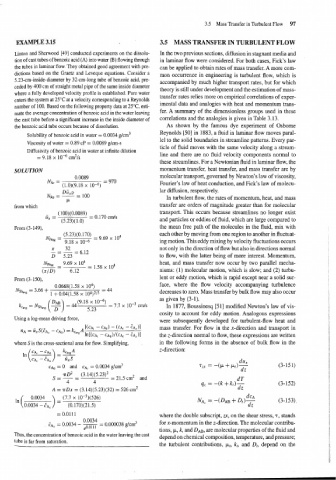
      Linton and Sherwood [49] conducted experiments on the dissolu-   In the two previous sections, diffusion in stagnant media and
      tion of cast tubes of benzoic acid (A) into water (B) flowing through   in laminar flow were considered. For both cases, Fick's law
      the tubes in laminar flow. They obtained good agreement with pre-   can be applied to obtain rates of mass transfer. A more com-
      dictions based on the Graetz and Leveque equations. Consider a
                                                          mon  occurrence in engineering is turbulent  flow, which is
      5.23-cm-inside-diameter by  32-cm-long tube of benzoic acid, pre-   accompanied by much higher transport rates, but for which
      ceded by 400 cm of straight metal pipe of the same inside diameter   theory is still under development and the estimation of mass-
      where a fully developed velocity profile is established. Pure water
      enters the system at 25'C  at a velocity corresponding to a Reynolds   transfer rates relies more on empirical correlations of exper-
      number of 100. Based on the following property data at 25°C esti-   imental data and analogies with heat and momentum trans-
      mate the average concentration of benzoic acid in the water leaving   fer. A summary of the dimensionless  groups used  in these
      the cast tube before a significant increase in the inside diameter of   correlations and the analogies is given in Table 3.13.
      the benzoic acid tube occurs because of dissolution.   As  shown  by  the  famous  dye  experiment  of  Osborne
           Solubility of benzoic acid in water = 0.0034 &m3   Reynolds [50] in 1883, a fluid in laminar flow moves paral-
                                                          lel to the solid boundaries in streamline patterns. Every par-
           Viscosity of water = 0.89 cP = 0.0089 g/cm-s
                                                          ticle of fluid moves with the same velocity along a stream-
           Diffusivity of benzoic acid in water at infinite dilution
              = 9.18 x    cmqs                            line and there  are no fluid velocity  components normal to
                                                          these streamlines. For a Newtonian fluid in laminar flow, the
      SOLUTION                                            mornenturn transfer, heat transfer, and mass transfer are by
                                                          molecular transport, governed by Newton's law of viscosity,
                                                          Fourier's law of heat conduction, and Fick's law of molecu-
                                                          lar diffusion, respectively.
                                                            In tu~bulent flow, the rates of momentum, heat, and mass
      from which                                          transfer are orders of magnitude greater than for molecular
                                                          transport.  This occurs because  streamlines no longer exist
                                                          and particles or eddies of fluid, which are large compared to
      From (3-149),                                       the mean free path of the molecules  in the fluid, mix with
                                                          each other by moving from one region to another in fluctuat-
                                                          ing motion. This eddy mixing by velocity fluctuations occurs
                                                          not only in the direction of flow but also in directions normal
                                                          to flow, with the latter being of more interest. Momentum,
                                                          heat,  and mass transfer now occur by  two parallel  mecha-
                                                          nisms: (1) molecular motion, which is slow; and (2) turbu-
                                                          lent or eddy motion, which is rapid except near a solid sur-
      From (3-150),
                                                          face,  where  the  flow  velocity  accompanying  turbulence
                                                          decreases to zero. Mass transfer by bulk flow may also occur
                                                          as given by (3-1).
                                                            In 1877, Boussinesq [51] modified Newton's  law of vis-
                                                          cosity  to account for eddy motion. Analogous expressions
      Using a log-mean driving force,
                                                          were  subsequently  developed  for  turbulent-flow  heat  and
                                                          mass transfer. For flow in the x-direction and transport in
                                                          the z-direction normal to flow, these expressions are written
      where S is the cross-sectional area for flow. Simplifying,   in the following forms in the absence of  bulk flow in the
                                                          z-direction:

                   CA~ = 0  and   CA,  = 0.0034 g/cm3

                                                   and


                     = 0.01 11                            where the double subscript, zx, on the shear stress, 7, stands
                               0.0034
                  FA, = 0.0034 - - 0.000038 g/cm3         for x-momentum in the z-direction. The molecular contribu-
                                    =
                               ,0.0111
                                                          tions, p, k, and DAB, are molecular properties of the fluid and
      Thus, the concentration of benzoic acid in the water leaving the cast   depend on chemical composi~on,   and pressure;
      tube is far from saturation.
                                                          the  turbulent  contributions,  p,,  kt, and D,, depend  on the

