


Page 131 - Separation process principles 2
P. 131
96  Chapter 3  Mass Transfer and Diffusion


                    The entry length to achieve fully developed flow is de-   The Graetz solution of (3-147) for the temperature profile
                  fined as the axial distance, L,,  from the entrance to the point   or  the  concentration profile  is  in  the  form  of  an  infinite
                  at which the centerline velocity is 99% of  the fully devel-   series, and can be obtained from (3-146) by the method of
                  oped flow value. From the analysis of Langhaar [43] for the   separation of  variables using  the method  of  Frobenius. A
                  entry region,                                      detailed solution is given by Sellars, Tribus, and Klein [45].
                                                                     From the concentration profile, expressions for the  mass-
                                                                     transfer coefficient and the Sherwood number are obtained.
                                                                     When x is large, the concentration profile is fully developed
                  Thus, at the upper limit of laminar flow,  NR, = 2,100, L,/D  =   and the local Sherwood number, Nshx, approaches a limiting
                  12 1, a rather large ratio. For NRe = 100, the ratio is only 5.75.   value of  3.656. At the other extreme, when x is small such
                  In the entry region, Langhaar's analysis shows the friction fac-   that the concentration boundary layer is very thin and con-
                  tor is considerably higher than the fully developed flow value   fined to a region where the fully developed velocity profile is
                  given by (3-144). At x = 0, f is infinity, but then decreases ex-   linear, the  local  Sherwood  number is  obtained  from  the
                  ponentially withx, approaching the fully developed flow value   classic Leveque  [46] solution, presented  by  Knudsen and
                  at L,.  For example, for NRe = 1,000, (3-144) gives f = 0.016,   Katz [47]:
                  with L,/D  = 57.5. In the region fromx = 0 tox/D = 5.35, the
                  average friction factor from Langhaar is 0.0487, which is
                  about three times higher than the fully developed value.
                    In  1885, Graetz [44] obtained a theoretical solution to
                 the problem of convective heat transfer between the wall of   where
                  a circular tube, held at a constant temperature, and a fluid
                  flowing through the tube in fully developed laminar flow.
                 Assuming constant properties and negligible conduction in
                 the  axial direction, the energy equation, after substituting
                 (3-140) for u,,  is
                                                                       The limiting solutions, together with the general Graetz
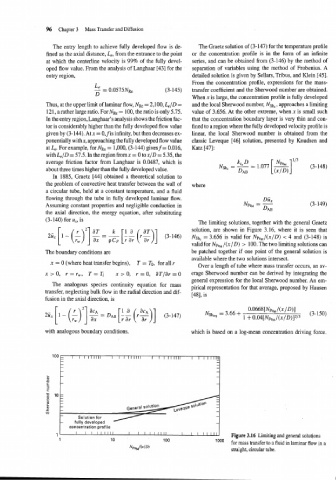
                                                                     solution, are  shown in  Figure 3.16, where  it  is  seen that
                                                                     NShx = 3.656 is valid for NpeM/(x/D) < 4 and (3-148) is
                                                                     valid for NpeM /(XI D) > 100. The two limiting solutions can
                 The boundary conditions are                         be patched together if  one point of  the general solution is
                                                                     available where the two solutions intersect.
                   x = 0 (where heat transfer begins),  T  = To, for all r
                                                                       Over a length of tube where mass transfer occurs, an av-
                                                                     erage Sherwood number can be  derived by  integrating the
                                                                     general expression for the local Sherwood number. An em-
                    The  analogous  species  continuity  equation  for  mass
                                                                     pirical representation for that average, proposed by Hausen
                 transfer, neglecting bulk flow in the radial direction and dif-
                                                                     [48], is
                 fusion in the axial direction, is


                 with analogous boundary conditions.                 which is based on a log-mean concentration driving force.


                  V)
                            fullv develooed
                      (   concentration profile                                I
                     11     I   1   1   1 1 1 1 1 1  I   1   1   1 1  1 1 1 1  I   I   1  1  1 1 1 1 1  Figure 3.16  Limiting and general solutions
                      1                 10                 100               looO
                                                                                   for mass transfer to a fluid in laminar flow in a
                                               NPeM/(xID)
                                                                                   straight, circular tube.

