


Page 126 - Separation process principles 2
P. 126
3.4  Molecular Diffusion in Laminar Flow  91


         This equation was solved by Johnstone and Pigford [33]   For mass transfer, a composition driving force replaces
      and later by Olbrich and Wild [34], for the following bound-   AT. As discussed later in this chapter, because composition
      ary conditions:                                     can  be  expressed  in  a  number  of  ways,  different  mass-
                                                          transfer coefficients are defined. If we select AcA as the dri-
                  CA  = CA,  at z  = 0  for y  > 0
                                                          ving force for mass transfer, we can write
                  CA  = CA~ at y = 0  for 0 < z  < 6
              acA/az=O  atz=6  forO<y<L                                    n~ = kc A AcA            (3-105)

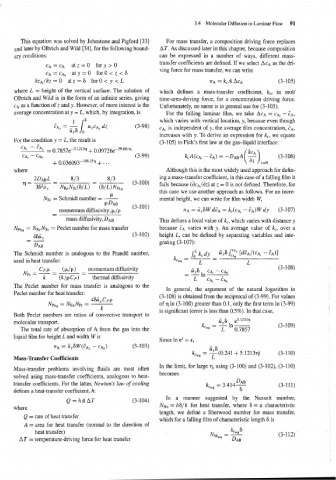
      where L = height of  the vertical surface. The solution of   which  defines  a  mass-transfer  coefficient,  kc,  in
      Olbrich and Wild is in the form of an infinite series, giving   time-area-driving force, for a concentration driving force.
      CA as a function of z and y. However, of more interest is the   Unfortunately, no name is in general use for (3-105).
      average concentration at y = L, which, by integration, is   For the  falling laminar film, we  take  AcA = cA, - ZA,
                                                          which varies with vertical location, y, because even though
                                                          CA,  is independent of y, the average film concentration, CA,
                                                          increases with y. To derive an expression for kc, we equate
      For the condition y = L, the result is              (3-105) to Fick's first law at the gas-liquid  interface:


                                    +
                                      .
                                        .
                    + 0.036093-'~~.~~~
                                       .
      where                                                 Although this is the most widely used approach for defin-
                                                          ing a mass-transfer coefficient, in this case of a falling film it
                                                          fails because (acA/az) at z = 0 is not defined. Therefore, for
                                                          this case we use another approach as follows. For an incre-
                                        P
                 Nsc = Schmidt number =                   mental height, we can write for film width W,
                                                (3-101)
                      momentum diffusivity, b/p
                    -                  -  .  ..
                         mass diffusivity, DAB            This defines a local value of kc, which varies with distance y
      NPeM = NReNSc = Peclet number for mass transfer     because CA  varies with y. An  average value of  kc, over a
             46Uy                               (3- 102)   height L,  can be defined by  separating variables and inte-
           --                                             grating (3-107):
           -
             DAB
      The  Schmidt number is analogous to the Prandtl number,        S:  kc d~   i,6 SCAL [dCA/(cA, - ?A)]
                                                                                   CAo
                                                                            -
                                                                            -
      used in heat transfer:                                   kcavg = -
                                                                        L               L
               CP P    (PIP)    momentum diffusivity                 iy8  $4, - CA~                 (3- 108)
         Npr=-=------         -                                   - -
                 k    (kip Cp)    thermal diffusivity
                                                                      L   CA.  - ?A,
      The  Peclet number for  mass  transfer is  analogous to  the
                                                            In  general,  the  argument  of  the  natural  logarithm  in
      Peclet number for heat transfer:
                                                          (3-108) is obtained from the reciprocal of (3-99). For values
                                                          of 7 in (3-100) greater than 0.1, only the first term in (3-99)
                                                          is significant (error is less than 0.5%). In that case,
      Both Peclet numbers  are ratios of  convective transport to
      molecular transport.
         The total rate of  absorption of A from the gas into the
      liquid film for height L and width W is
                                                          Since In ex = x,
                    n~ = iyGW(EAL - cAo)        (3-103)
      Mass-Transfer Coefficients
                                                          In the limit, for large 'q,  using (3-100) and (3-102), (3-110)
      Mass-transfer  problems  involving  fluids  are  most  often
                                                          becomes
      solved using mass-transfer coefficients, analogous to heat-
      transfer coefficients. For the latter, Newton S law of cooling
      defines a heat-transfer coefficient, h:
                                                            In  a  manner  suggested  by  the  Nusselt  number,
                         Q=hAAT                 (3- 104)
                                                          NNu = h6lk  for  heat  transfer, where  6 = a  characteristic
      where
                                                          length, we  define a  Sherwood number for  mass  transfer,
          Q = rate of heat transfer
                                                          which for a falling film of characteristic length 6 is
          A  = area for heat  transfer (normal to  the direction of
              heat transfer)
        AT  = temperature-driving force for heat transfer

