


Page 123 - Separation process principles 2
P. 123
88  Chapter 3  Mass Transfer and Diffusion

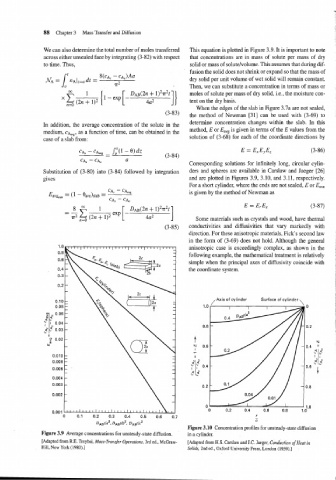
                 We can also determine the total number of moles transferred   This equation is plotted in Figure 3.9. It is important to note
                 across either unsealed face by integrating (3-82) with respect   that  concentrations are in mass of  solute per  mass of  dry
                 to time. Thus,                                     solid or mass of solute/volume. This assumes that during dif-
                                                                    fusion the solid does not shrink or expand so that the mass of
                                                                    dry solid per unit volume of wet solid will remain constant.
                                1  {         [   DAB(^^ -k  l)'Ti2t] 1   Then, we can substitute a concentration in terms of mass or
                                                                    moles of solute per mass of dry solid, i.e., the moisture con-
                                      1 - exp  -
                         C (2n + 112                 4a2            tent on the dry basis.
                         n=O
                                                                       When the edges of the slab in Figure 3.7a are not sealed,
                                                            (3-83)
                                                                    the  method  of  Newnian  [31] can  be  used  with  (3-69) to
                 In  addition, the  average concentration of  the solute in the   determine concentration changes  within  the  slab.  In  this
                 medium, CA,,,,  as a function of time, can be obtained in the   method, E or Eavg is given in terms of the E values from the
                                                                    solution of  (3-68) for each of the coordinate directions by
                 case of a slab from:


                                                                    Corresponding solutions for infinitely long, circular cylin-
                 Substitution of  (3-80) into  (3-84) followed by  integration   ders and spheres are available in Carslaw and Jaeger  [26]
                 gives                                              and are plotted in Figures 3.9, 3.10, and 3.11, respectively.
                                                                    For a short cylinder, where the ends are not sealed, E or Eav,
                                                                    is given by the method of Newman as


                                                                      Some materials such as crystals and wood, have thermal
                                                                    conductivities  and  diffusivities  that  vary  markedly  with
                                                                    direction. For these anisotropic materials, Fick's second law
                                                                    in the form of  (3-69) does not hold. Although the general
                                                                    anisotropic case is exceedingly complex, as shown in the
                                                                    following example, the mathematical treatment is relatively
                                                                    simple when the principal axes of diffusivity coincide with
                                                                    the coordinate system.


                                                                            ,Axis  of  cylinder   Surface of  cylinder,


                        0    0.1   0.2   0.3   0.4   0.5   0.6   0.7
                                                                                           0
                                   DABt/a2, DABt/b2, D~~~/c~
                                                                   Figure 3.10  Concentration profiles for unsteady-state diffusion
                Figure 3.9  Average concentrations for unsteady-state diffusion.   in a cylinder.
                [Adapted from R.E. Treybal, Mass-Transfer Operations, 3rd ed., McGraw-   [Adapted from H.S. Carslaw and J.C. Jaeger, Conduction of Heat in
                Hill, New York (1980).]                            Solids, 2nd ed., Oxford University Press, London (1959).]

