


Page 119 - Separation process principles 2
P. 119
84  Chapter 3  Mass Transfer and Diffusion

                 The structure of wood,  which often consists of  (1) highly   Typical results are given by Sherwood [25] and Stamm [24].
                 elongated hexagonal or rectangular cells, called tracheids in   For example, for beech  with a swollen specific gravity of
                 softwood (coniferous species, e.g., spruce, pine, and fir) and   0.4,  the  diffusivity  increases  from  a  value  of  about
                 fibers in hardwood (deciduous or broad-leaf species, e.g.,   1 x   cm2/s at 10°C to 10 x lop6 cm2/s at 60°C.
                 oak, birch, and walnut); (2) radial arrays of rectangular-like
                 cells, called rays, which are narrow and short in softwoods
                                                                    3.3  ONE-DIMENSIONAL, STEADY-STATE
                 but wide and long in hardwoods; and (3) enlarged cells with
                                                                    AND UNSTEADY-STATE, MOLECULAR
                 large pore spaces and thin walls, called sap channels because
                 they  conduct fluids up the tree. The sap channels are less   DIFFUSION THROUGH STATIONARY MEDIA
                 than  3  vol%  of  softwood,  but  as  much  as  55  vol%  of   For conductive heat transfer in stationary media, Fourier's
                 hardwood.                                          law is applied to derive equations for the rate of heat transfer
                   Because the structure of wood is directional, many of its   for steady-state and unsteady-state conditions in shapes such
                 properties  are  anisotropic.  For  example,  stiffness  and   as slabs, cylinders, and spheres. Many of the results are plot-
                 strength are 2 to 20 times greater in the axial direction of the   ted in  generalized charts. Analogous equations can be de-
                 tracheids or fibers than in the radial and tangential directions   rived for mass transfer, using simplifying assumptions.
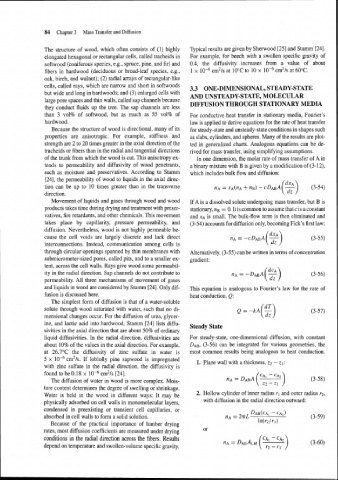
                 of the trunk from which the wood is cut. This anisotropy ex-   In one dimension, the molar rate of mass transfer of A in
                 tends to  permeability and  diffusivity of  wood  penetrants,   a binary mixture with B is given by a modification of (3-12),
                 such  as  moisture  and  preservatives. According to  Stamm   which includes bulk flow and diffusion:
                 [24], the permeability of wood to liquids in the axial direc-
                 tion  can be  up  to  10 times  greater than  in  the transverse
                 direction.
                   Movement of liquids and gases through wood and wood   If A is a dissolved solute undergoing mass transfer, but B is
                 products takes time during drying and treatment with preser-   stationary,  ng = 0. It is common to assume that c is a constant
                 vatives, fire retardants, and other chemicals. This movement   and XA  is small. The bulk-flow term is then eliminated and
                 takes  place  by  capillarity,  pressure  permeability,  and   (3-54) accounts for diffusion only, becoming Fick's first law:
                 diffusion. Nevertheless, wood is not highly permeable be-
                 cause the  cell  voids  are  largely  discrete  and  lack  direct
                 interconnections.  Instead,  communication  among cells  is
                 through circular openings spanned by thin membranes with   Alternatively, (3-55) can be written in terms of concentration
                 submicrometer-sized pores, called pits, and to a smaller ex-   gradient:
                 tent, across the cell walls. Rays give wood some permeabil-
                 ity in the radial direction. Sap channels do not contribute to
                 permeability. All three mechanisms of  movement of  gases
                 and liquids in wood are considered by Stamm [24]. Only dif-   This equation is analogous to Fourier's  law for the rate of
                 fusion is discussed here.                          heat conduction, Q:
                   The simplest form of diffusion is that of a water-soluble
                 solute through wood  saturated with water, such that no di-
                 mensional changes occur. For the diffusion of urea, glycer-
                 ine, and lactic acid into hardwood, Stamm [24] lists diffu-   Steady State
                 sivities in the axial direction that are about 50% of ordinary
                 liquid diffusivities. In the radial direction, diffusivities are   For  steady-state, one-dimensional diffusion, with  constant
                 about 10% of the values in the axial direction. For example,   DAB, (3-56) can be  integrated for various geometries, the
                 at  26.7"C  the  diffusivity  of  zinc  sulfate  in  water  is   most common results being analogous to heat conduction.
                 5 x  lop6 cm2/s. If  loblolly pine  sapwood is  impregnated   1. Plane wall with a thickness, 22 - zl:
                 with  zinc sulfate in  the radial  direction, the  diffusivity is
                 found to be 0.18 x   cm2/s [24].
                   The diffusion of  water in wood is more complex. Mois-
                 ture content determines the degree of swelling or shrinkage.
                 Water  is  held  in  the  wood  in  different  ways:  It  may  be   2.  Hollow cylinder of inner radius rl and outer radius r2,
                 physically adsorbed on cell walls in monomolecular layers,   with diffusion in the radial direction outward:
                 condensed  in  preexisting  or  transient  cell  capillaries,  or
                 absorbed in cell walls to form a solid solution.
                   Because  of  the  practical  importance of  lumber drying
                 rates, most diffusion coefficients are measured under drying
                 conditions in the radial direction across the fibers. Results
                 depend on temperature and swollen-volume specific gravity.

