


Page 120 - Separation process principles 2
P. 120
3.3  One-Dimensional, Steady-State and Unsteady-State, Molecular Diffusion through Stationary Media  85


            where                                         Rearranging and simplifying,
              ALM = log mean of the areas 2n-rL at rl  and r2
                 L = length of the hollow cylinder
          3.  Spherical shell of inner radius rl  and outer radius r2,
                                                          In the limit, as Az + 0,
            with diffusion in the radial direction outward:


                                                             Equation (3-68) is Fick's  second law for one-dimensional
                                                          diffusion. The more general form, for three-dimensional rec-
                                                          tangular coordinates, is

            where AGM = geometric mean of  the areas 4n-r2 at
            rl  and r2.
         When rllrz < 2, the  arithmetic mean  area is no  more   For one-dimensional  diffusion  in the radial direction  only,
       than 4% greater than the log mean area. When rl/r2 < 1.33,   for cylindrical and spherical coordinates, Fick's  second law
       the arithmetic mean area is no more than 4% greater than the   becomes, respectively,
       geometric mean area.

       Unsteady State
                                                          and
       Equation (3-56) is applied to unsteady-state molecular diffu-
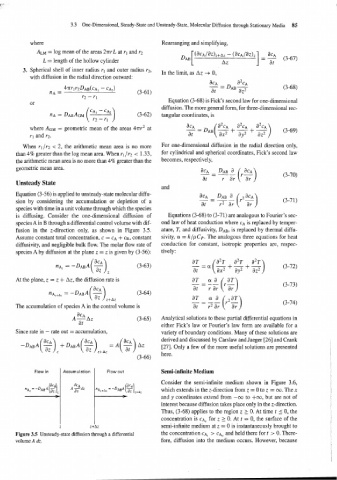
       sion  by  considering  the  accumulation  or  depletion  of  a
       species with time in a unit volume through which the species
       is  diffusing.  Consider  the  one-dimensional  diffusion  of   Equations (3-68) to (3-71) are analogous to Fourier's sec-
       species A in B through a differential control volume with dif-   ond law of heat conduction where CA is replaced by temper-
       fusion  in  the  z-direction  only,  as  shown  in  Figure  3.5.   ature, T, and diffusivity, DAB, is replaced by thermal diffu-
       Assume constant total concentration, c = CA + CB, constant   sivity, ci = klp Cp. The analogous three equations for heat
       diffusivity, and negligible bulk flow. The molar flow rate of   conduction  for  constant,  isotropic  properties  are,  respec-
       species A by diffusion at the plane z = z is given by (3-56):   tively:


       At the plane, z = z + Az, the diffusion rate is


       The accumulation of species A in the control volume is

                             ~CA
                           A-   AZ                (3-65)   Analytical solutions to these partial differential equations in
                             at                           either Fick's  law or Fourier's  law form are available for a
       Since rate in - rate out = accumulation,           variety of boundary conditions. Many of these solutions are
                                                          derived and discussed by Carslaw and Jaeger [26] and Crank
         -DABA($)z+DABA($)              =A(%)AZ            [27]. Only a few of the more useful solutions are presented
                                    z+Az                  here.
                                                  (3-66)
              FIOW in  1  Accumulation  I   FIOW out      Semi-infinite Mediu111


                                                          Consider  the  semi-infinite  medium  shown  in  Figure  3.6,
                                                          which extends in the z-direction from z = 0 to z = oo. The x
                                                          and y coordinates extend from -oo  to +oo, but are not of
                                                          interest because diffusion takes place only in the z-direction.
                                                          Thus, (3-68) applies to the region z >_  0. At time t 5 0, the
                                                          concentration is CA~ for z > 0. At t = 0, the surface of the
                       z         Z+AZ                     semi-infinite medium at  = 0 is instantaneously  brought to
       Figure 3.5  Unsteady-state diffusion through a differential   the concentration CA,  > CA,  and held there for t  > 0. There-
       volume A dz.                                       fore, diffusion into the medium  occurs. However, because

