


Page 124 - Separation process principles 2
P. 124
3.3  One-Dimensional, Steady-State and Unsteady-State, Molecular Diffusion through Stationary Media  89


               ,Center   of sphere   Surface of sphere,   Since this is the same form as (3-69) and since the boundary condi-
                                                          tions do not involve diffusivities, we can apply Newman's method,
                                                          using Figure 3.9, where concentration, c~, is replaced by  weight-
                                                          percent moisture on a dry basis.
                                                             From (3-86) and (3-85),


                                                          Let D = 1 x  lo-'  cm2/s.

                                                          zl Direction (axial):


                                                          y 1 Direction:
                               -
                               a                                               10  1 x     'I2
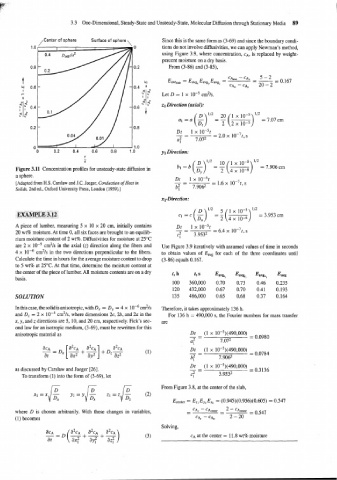
       Figure 3.11  Concentration profiles for unsteady-state diffusion in   b  = b (   = - ( 4 x  lo-6   = 7.906 cm
                                                                               2
       a sphere.
                                                               ~t   1  103
                                                                                       s
       [Adapted from H.S. Carslaw and J.C. Jaeger, Conduction of Heat in   -- -   = 1.6 x l~-~t,
       Solids, 2nd ed., Oxford University Press, London (1959).]   b:   7.9062


       EXAMPLE 3.12
       A piece of  lumber, measuring 5 x  10 x 20 cm, initially contains
       20 wt% moisture. At time 0, all six faces are brought to an equilib-
       rium moisture content of 2 wt%. Diffusivities for moisture at 25°C
       are 2 x  lo-'  cm2/s in the axial (z) direction along the fibers and   Use Figure 3.9 iteratively with assumed values of  time in seconds
       4 x  lop6 cm2/s in the two directions perpendicular to the fibers.   to  obtain  values  of  Eavg for each  of  the  three  coordinates until
       Calculate the time in hours for the average moisture content to drop   (3-86) equals 0.167.
       to 5 wt% at 25OC. At that time, determine the moisture content at
       the center of the piece of lumber. All moisture contents are on a dry
       basis.


       SOLUTION
       In this case, the solid is anisotropic, with Dx = D,  = 4 x low6 cm2/s   Therefore, it takes approximately 136 h.
       and D,  = 2 x lo-'  cm2/s, where dimensions 2c, 2b, and 2a in the   For 136 h = 490,000 s, the Fourier numbers for mass transfer
       x, y, and z directions are 5, 10, and 20 cm, respectively. Fick's sec-   are
       ond law for an isotropic medium, (3-69), must be rewritten for this
                                                                    Dt
       anisotropic material as                                      - - (1 x  10-5)(490,000)   = 0.0980
                                                                       -
                                                                    a?         7.072


       as discussed by Carslaw and Jaeger 1261.
         To transform (1) into the form of  (3-69), let

                                                          From Figure 3.8, at the center of the slab,

                                                              Ecen.,  = E,, E,,  Ex, = (0.945)(0.956)(0.605) = 0.547
       where D  is  chosen  arbitrarily. With  these  changes in  variables,
       (1) becomes
                                                          Solving,
                                                    (3)             CA at the center = 11.8 wt% moisture

