


Page 127 - Separation process principles 2
P. 127
92  Chapter 3  Mass Transfer and Diffusion


                  From (3-1 ll), NSh,,, = 3.414, which  is the smallest value   The error function is defined as
                  that the Shenvood number can have for a falling liquid film.
                    The average mass-transfer flux of A is given by

                                                                     Using the Leibnitz rule with (3-116) to differentiate this in-
                                                                      tegral function,
                    For  values -q < 0.001  in  (3-loo), when  the liquid-film                      I
                  flow regime is still laminar without ripples, the time of con-
                  tact of the gas with the liquid is short and mass transfer is
                  confined to the vicinity of the gas-liquid  interface. Thus, the   Substituting (3-119) into (3-117) and introducing the Peclet
                  film acts as if  it were infinite in thickness. In this limiting   number for mass transfer from (3-102), we obtain an expres-
                  case, the downward velocity of the liquid film in the region   sion for the local mass-transfer coefficient as a function of
                  of mass transfer is just uym,, and (3-96) becomes   distance down from the top of the wall:

                                     a CA      a2CA
                                 ~y,,  - DAB -              (3-1 14)
                                         =
                                     a~        az2                                      snys                   (3-120)
                  Since from (3-90) and (3-91), u,,,   = 3iiy/2, (3-114) can be
                  rewritten as                                       The average value of kc over the height of the film, L, is ob-
                                                                     tained by integrating (3-120) with respect to y, giving
                                                            (3-115)
                                                                                                               (3-121)
                  where the boundary conditions are
                                                                     Combining (3-121) with (3-112) and (3-102),
                            CA = CA~  for z  > 0   and y  > 0
                            CA  = CA,  for z = 0   and y > 0                          = /
                                                                                 s                 =           11-12?)
                            CA  = C&  for large z  and y  > 0
                  Equation (3-1 15) and the boundary conditions are equivalent   where, by (3-108), the proper mean to use with kc,% is the log
                  to the case of the semi-infinite medium, as developed above.   mean. Thus,
                  Thus, by analogy to (3-68), (3-73, and (3-76) thesolution is
                                                                        (cAi - CA)rnean = (cAi - ?A)LM
                                                                                                               (3-123)
                  E=I-O=      CA, - CA   erf      z     (3-116)                     -  (CA,  - CAO)  - (CA~ - CAL)
                                                                                    -
                             CA, - CA~      2                                         ln[(c~, - CA~)/(CA, - ;A,>]
                  Assuming that the driving force for mass transfer in the film   When ripples are present, values of kc=,, and NSh,,, can be
                  is CA,  - c&, we  can  use Fick's  first law at the gas-liquid   considerably larger than predicted by these equations.
                  interface to define a mass-transfer coefficient:      In the above development, asymptotic, closed-form solu-
                                                                     tions  are  obtained with  relative  ease  for  large and  small
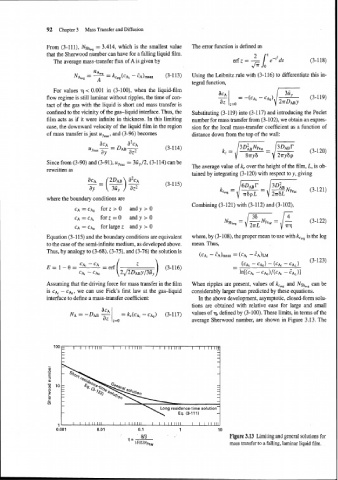
                                                                     values of q, defined by (3-100). These limits, in terms of the
                                            =kc(c~,-c~,) (3-117)
                                                                     average Sherwood number, are shown in Figure 3.13. The


                       -
                       L   I  (  1 1  11111   I  I  1 1 1 1 1 1 1  I  1  1  1llll1   I  I  I I I Ilr
                       -
                       -                                                      -
                                                                              -
                       -                                                      -
                       -                                                      -
                                                                              -
                                                                              -
                                                                              -
                                                                              -
                                                                              -
                       -                                                      -
                                                                              -
                       -                                                      -
                       -                                                      -
                       -
                                                          Long residence-time solution-
                       -                                                      -
                                                                 Eq. (3-1 11)
                           I   I  1  111111   I   I  1  1 1  1111   I  I  1  111111   I  I  111111.
                                                                               10
                                                                                   Figure 3.13  Limiting and general solutions for
                                                                                   mass transfer to a falling, laminar liquid film.

