


Page 122 - Separation process principles 2
P. 122
F-


                           3.3  One-Dimensional, Steady-State and Unsteady-State, Molecular Diffusion through Stationary Media   87


        transfer can be greatly increased by  agitation to induce turbulent   /Center  of  slab   Surface of slab,
     ?i
        motion  For solids, it is best to reduce the diffusion path to as small
        a dimension as possible by reducing the size of the solid.


        Medium of Finite Thickness with Sealed Edges
        consider  a  rectangular,  parallelepiped  medium  of  finite
        thickness  2a  in  the  z-direction, and  either infinitely  long
        dimensions in the y- and x-directions or finite lengths of 2b
        and 2c, respectively, in those directions. Assume that in Fig-
       ure 3.7a the edges parallel to the z-direction are sealed, so
        diffusion occurs only in the z-direction and initially the con-
        centration of the solute in the medium is uniform at CA~. At
       time t = 0, the two unsealed surfaces of the medium at  =
        20 are brought to and held at concentration cAS > cAo. Be-
       cause of symmetry, &A/&   = 0 at z = 0. Assume constant                    -
                                                                                   L
       D~ Again (3-68) applies, and an exact solution can be ob-                  a
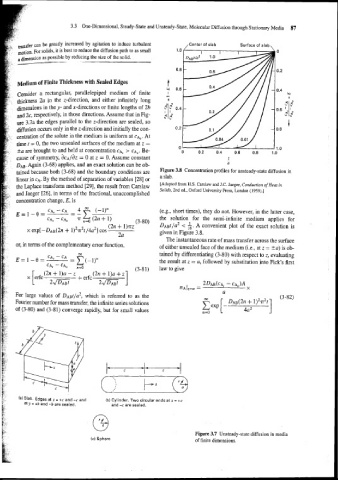
       tained because both (3-68) and the boundary conditions are   Figure 3.8  Concentration profiles for unsteady-state diffusion in
                                                          a slab.
       linear in CA. By the method of separation of variables [28] or
                                                          [Adapted from H.S. Carslaw and J.C. Jaeger, Conduction ofHeat in
       the Laplace transform method [29], the result from Carslaw
                                                          Solids, 2nd ed., Oxford University Press, London (1959).]
       and Jaeger [26], in terms of the fractional, unaccomplished
       concentration change, E, is
                   CA>-CA  =-c--
       E=l-0=                4   00                       (e.g., short times), they do not. However, in the latter case,
                  CA,-CA,    nnn=(2n+1)                   the  solution  for  the  semi-infinite  medium  applies  for
                                                          DAB~/U~ < h. A convenient plot  of  the exact solution is
                                        (2n + 1)nz (3-80)
                         +
           X e~p[-D~~(2n I)~IT~~/~U~]                     given in Figure 3.8.
                                     COS
                                            2a
                                                             The instantaneous rate of mass transfer across the surface
       or, in terms of the complementary error function,
                                                          of either unsealed face of the medium (i.e., at z = +a) is ob-
                             CO                           tained by differentiating (3-80) with respect to z, evaluating
                   CAS - CA
       E=~-B=              = C(-l)"                       the result at z  = a, followed by substitution into Fick's first
                  CAs  - CAo   n=~                (3-81)   law to give
                 (2n + l)a - z     (2n + l)a + z
           x [edc            + erfc           I
                                                                                  -
                   2miz              2-                                   ~DAB(CA$ CAJA
                                                                 nAIz=a  =
                                                                                 a
       For  large  values  of  ~~~t/a~, which  is  referred to  as  the                              (3-82)
       Fourier number for mass transfer, the infinite series solutions    2 exp [    DAB(^^ + 1)'n2t]
                                                                                 -
       of (3-80) and (3-81) converge rapidly, but for small values
                                                                          n=O           4a2


        (a) Slab.  Edges at x  = tc and -C  and   (b) Cylinder. Two circular ends at x = tc
             =
          at~ +b and -b are sealed.      and -c  are sealed.


                                                                       Figure 3.7  Unsteady-state diffusion in media
                                  (c) Sphere
                                                                       of finite dimensions.

