


Page 144 - Separation process principles 2
P. 144
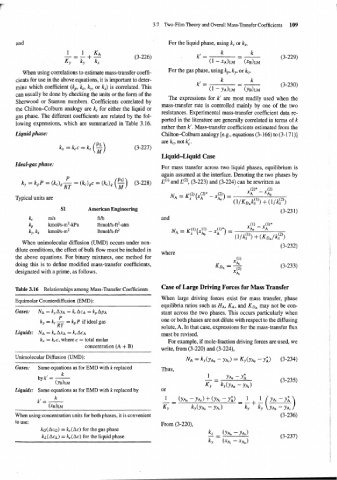
3.7  Two-Film Theory and Overall Mass-Transfer Coefficients  109


       and                                                   For the liquid phase, using kc or k,,


                                                             For the gas phase, using k,,  ky, or kc,
         When using correlations to estimate mass-transfer coeffi-
       cients for use in the above equations, it is important to deter-        k     -    k
                                                                       kt =          --             (3-230)
       mine which coefficient (k,,  kc, k,,  or k,)  is correlated. This
                                                                           (1 - YA)LM  (YB)LM
       can usually be done by checking the units or the form of the
                                                             The expressions for kt are most readily  used  when the
       Sherwood or  Stanton numbers. Coefficients correlated by
       the Chilton-Colburn  analogy are kc for either the liquid or   mass-transfer rate is controlled mainly by  one of  the two
                                                          resistances. Experimental mass-transfer coefficient data re-
       gas phase. The different coefficients are related by the fol-
                                                          ported in the literature are generally correlated in terms of k
       lowing expressions, which  are summarized in Table 3.16.
                                                          rather than kt. Mass-transfer coefficients estimated from the
       Liquid phase:                                      Chilton-Colburn  analogy [e.g . , equations (3- 166) to (3- 17 I)]
                                                          are kc, not k:.

                                                          Liquid-Liquid Case
       ZdeaGgas phase:
                                                          For mass transfer across two liquid phases, equilibrium is
                                                          again assumed at the interface. Denoting the two phases by
                                                          L(') and L(~), (3-223) and (3-224) can be rewritten as

       Typical units are

                       SI       American Engineering
           kc     m/s               ft/h                  and
           k,     kmo~s-m2-k~a      lbmolih-ft2-atm                                      (1) - (I)*
                                                                     (1)
                                                                        (1)  -  (I)*
           k,,  kx   kmoUs-m2       lbmolih-ft2               N~ = Kx  (xAb  XA               X~
                                                                                ) = (l/k$l') + (KD~/~;~))
         When unimolecular diffusion (UMD) occurs under non-
                                                                                                    (3-232)
       dilute conditions, the effect of bulk flow must be included in                                                /I
                                                          where                                                      I I
       the above equations. For binary mixtures, one method for                     _(I)                             I
       doing this is to define modified mass-transfer coefficients,
       designated with a prime, as follows.

                                                          Case Of  Large Driving Forces for Mass
       Table 3.16  Relationships among Mass-Transfer Coefficients
                   -   -   --                        -
                                                          When  large driving  forces  exist  for  mass  transfer, phase
       Equimolar Counterdiffusion (EMD):
                                                          equilibria ratios such as HA, KA, and KDA may not be con-
       Gases:   NA = ky AyA = kc AcA = kp ApA             stant across the two phases. This occurs particularly when
                      P
               k,  = kc - kp P if ideal gas               one or both phases are not dilute with respect to the diffusing
                         =
                     R T                                  solute, A. In that case, expressions for the mass-transfer flux
       Liquids:  NA = k,  AxA = kc heA                    must be revised.
               kx = kcc, where c = total molar              For example, if mole-fraction driving forces are used, we
                               concentration (A + B)
                                                          write, from (3-220) and (3-224),
       Unimolecular Diffusion (UMD):

       Gases:   Same equations as for EMD with k replaced   Thus,
                       k
               byk' = -
                     (YB)LM
       Liquids:  Same equations as for EMD with k replaced by
                                                           1
               I
              k  =-   k                                   --  -  (YA~ - YA,) + (YA, - Y;)  - 1 1  YA,  - YA
                  (XB)LM                                                                               *)
                                                                                            ky
                                                                                       ky
                                                           K~        ky (YA~ - YA,   -  +-(  YA~ - YA,
       When using concentration units for both phases, it is convenient                             (3-236)
       to use:
                                                          From (3-220),
                kG(AcG)  = kc(Ac) for the gas phase
                                                                           kx   (YA~ - YA,)
                                                                           - -
                kL(AcL) = kc(Ac) for the liquid phase                        -                      (3-237)
                                                                           k,   (XA, - XA,)

