


Page 532 - The Mechatronics Handbook
P. 532
0066_Frame_C20  Page 2  Wednesday, January 9, 2002  5:41 PM


                                                Communication       Operator Interface


                                                        Information Processing
                                          Low Power      Electronics, Software
                                                 Actuators             Sensors
                                               Power Modulation,    Energy Conversion,
                                               Energy Conversion     Signal Processing
                                                          Physical Process
                                                          Physical Process
                                                          Physical Process
                                          High Power
                                                       mixture of mechanical, fluid,
                                                       thermal, chemical, electrical
                                                        components/subsystems
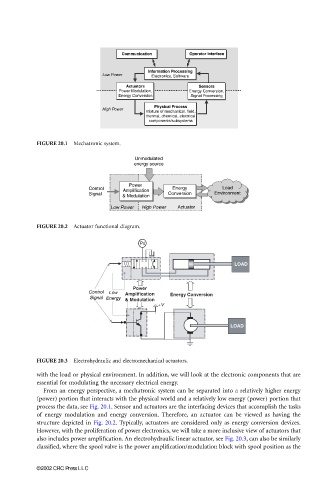
                       FIGURE 20.1  Mechatronic system.

                                                    Unmodulated
                                                    energy source


                                                  Power
                                                               Energy
                                      Control   Amplification  Energy         Load
                                                                Energy
                                                              Conversion
                                      Signal                  Conversion    Environment
                                                & Modulation  Conversion
                                             Low Power  High Power  Actuator
                       FIGURE 20.2  Actuator functional diagram.

                                                      Ps


                                                                                  LOAD


                                                   Power
                                      Control  Low  Amplification  Energy Conversion
                                      Signal  Energy  & Modulation
                                                           +V


                                                                                 LOAD


                       FIGURE 20.3  Electrohydraulic and electromechanical actuators.
                       with the load or physical environment. In addition, we will look at the electronic components that are
                       essential for modulating the necessary electrical energy.
                         From an energy perspective, a mechatronic system can be separated into a relatively higher energy
                       (power) portion that interacts with the physical world and a relatively low energy (power) portion that
                       process the data, see Fig. 20.1. Sensor and actuators are the interfacing devices that accomplish the tasks
                       of energy modulation and energy conversion. Therefore, an actuator can be viewed as having the
                       structure depicted in Fig. 20.2. Typically, actuators are considered only as energy conversion devices.
                       However, with the proliferation of power electronics, we will take a more inclusive view of actuators that
                       also includes power amplification. An electrohydraulic linear actuator, see Fig. 20.3, can also be similarly
                       classified, where the spool valve is the power amplification/modulation block with spool position as the


                       ©2002 CRC Press LLC

