


Page 598 - The Mechatronics Handbook
P. 598
0066_Frame_C20  Page 68  Wednesday, January 9, 2002  5:49 PM


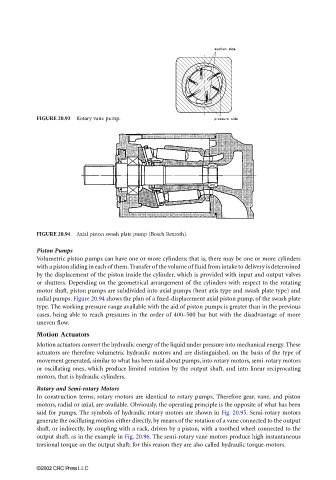
                       FIGURE 20.93  Rotary vane pump.


                       FIGURE 20.94  Axial piston swash plate pump (Bosch Rexroth).

                       Piston Pumps
                       Volumetric piston pumps can have one or more cylinders; that is, there may be one or more cylinders
                       with a piston sliding in each of them. Transfer of the volume of fluid from intake to delivery is determined
                       by the displacement of the piston inside the cylinder, which is provided with input and output valves
                       or shutters. Depending on the geometrical arrangement of the cylinders with respect to the rotating
                       motor shaft, piston pumps are subdivided into axial pumps (bent axis type and swash plate type) and
                       radial pumps. Figure 20.94 shows the plan of a fixed-displacement axial piston pump, of the swash plate
                       type. The working pressure range available with the aid of piston pumps is greater than in the previous
                       cases, being able to reach pressures in the order of 400–500 bar but with the disadvantage of more
                       uneven flow.
                       Motion Actuators
                       Motion actuators convert the hydraulic energy of the liquid under pressure into mechanical energy. These
                       actuators are therefore volumetric hydraulic motors and are distinguished, on the basis of the type of
                       movement generated, similar to what has been said about pumps, into rotary motors, semi-rotary motors
                       or oscillating ones, which produce limited rotation by the output shaft, and into linear reciprocating
                       motors, that is hydraulic cylinders.

                       Rotary and Semi-rotary Motors
                       In construction terms, rotary motors are identical to rotary pumps. Therefore gear, vane, and piston
                       motors, radial or axial, are available. Obviously, the operating principle is the opposite of what has been
                       said for pumps. The symbols of hydraulic rotary motors are shown in Fig. 20.95. Semi-rotary motors
                       generate the oscillating motion either directly, by means of the rotation of a vane connected to the output
                       shaft, or indirectly, by coupling with a rack, driven by a piston, with a toothed wheel connected to the
                       output shaft, as in the example in Fig. 20.96. The semi-rotary vane motors produce high instantaneous
                       torsional torque on the output shaft; for this reason they are also called hydraulic torque-motors.


                       ©2002 CRC Press LLC

