


Page 777 - The Mechatronics Handbook
P. 777
0066_Frame_C24  Page 25  Thursday, January 10, 2002  3:45 PM


                       and the composite system output is y(t) = y 1 (t). We thus obtain

                                             x ˙ 1 t()         x 1 t()
                                                   =  A 1    B 1 C 2  +  B 1 D 2   u t()       (24.146)
                                             x ˙ 2 t()  0  A 2  x 2 t()  B 2

                                                              x 1 t()
                                             y t() =  [ C 1 D 1 C 2 ]  + [ D 1 D ] u t()       (24.147)
                                                              x 2 t()    2


                       Parallel Connection
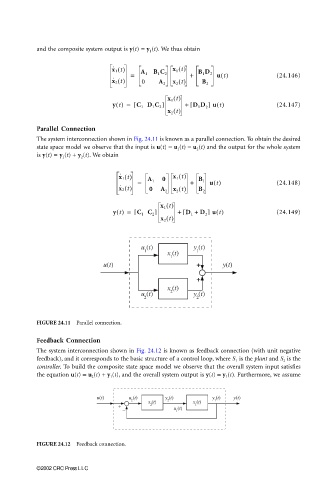
                       The system interconnection shown in Fig. 24.11 is known as a parallel connection. To obtain the desired
                       state space model we observe that the input is u(t) = u 1 (t) = u 2 (t) and the output for the whole system
                       is y(t) = y 1 (t) + y 2 (t). We obtain


                                               x ˙ 1 t()       x 1 t()
                                                     =  A 1  0       +  B 1   u t()            (24.148)
                                               x ˙ 2 t()  0  A 2 x 2 t()  B 2

                                                            x 1 t()
                                             y t() =  [ C 1 C 2 ]  + [ D 1 +  D ] u t()        (24.149)
                                                            x 2 t()      2


                                                      u (t)           y (t)
                                                       1               1
                                                              x (t)
                                                               1
                                           u(t)                        +      y(t)
                                                                       +
                                                              x (t)
                                                      u (t)    2      y (t)
                                                       2               2


                       FIGURE 24.11  Parallel connection.


                       Feedback Connection
                       The system interconnection shown in Fig. 24.12 is known as feedback connection (with unit negative
                       feedback), and it corresponds to the basic structure of a control loop, where S 1  is the plant and S 2  is the
                       controller. To build the composite state space model we observe that the overall system input satisfies
                       the equation u(t) = u 2 (t) + y 1 (t), and the overall system output is y(t) = y 1 (t). Furthermore, we assume


                                         u(t)     u (t)      y (t)         y (t)  y(t)
                                                   2    x (t)  2     x (t)  1
                                               +         2            1
                                                −               u (t)
                                                                1


                       FIGURE 24.12  Feedback connection.


                       ©2002 CRC Press LLC

