


Page 209 - Understanding Automotive Electronics
P. 209
2735 | CH 6  Page 196  Tuesday, March 10, 1998  1:10 PM


                6                     SENSORS AND ACTUATORS


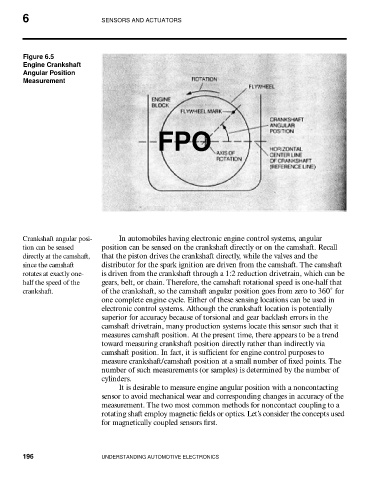
                Figure 6.5
                Engine Crankshaft
                Angular Position
                Measurement


                                                     FPO


                Crankshaft angular posi-  In automobiles having electronic engine control systems, angular
                tion can be sensed    position can be sensed on the crankshaft directly or on the camshaft. Recall
                directly at the camshaft,   that the piston drives the crankshaft directly, while the valves and the
                since the camshaft    distributor for the spark ignition are driven from the camshaft. The camshaft
                rotates at exactly one-  is driven from the crankshaft through a 1:2 reduction drivetrain, which can be
                half the speed of the   gears, belt, or chain. Therefore, the camshaft rotational speed is one-half that
                crankshaft.           of the crankshaft, so the camshaft angular position goes from zero to 360˚ for
                                      one complete engine cycle. Either of these sensing locations can be used in
                                      electronic control systems. Although the crankshaft location is potentially
                                      superior for accuracy because of torsional and gear backlash errors in the
                                      camshaft drivetrain, many production systems locate this sensor such that it
                                      measures camshaft position. At the present time, there appears to be a trend
                                      toward measuring crankshaft position directly rather than indirectly via
                                      camshaft position. In fact, it is sufficient for engine control purposes to
                                      measure crankshaft/camshaft position at a small number of fixed points. The
                                      number of such measurements (or samples) is determined by the number of
                                      cylinders.
                                          It is desirable to measure engine angular position with a noncontacting
                                      sensor to avoid mechanical wear and corresponding changes in accuracy of the
                                      measurement. The two most common methods for noncontact coupling to a
                                      rotating shaft employ magnetic fields or optics. Let’s consider the concepts used
                                      for magnetically coupled sensors first.


                196                   UNDERSTANDING AUTOMOTIVE ELECTRONICS

