


Page 103 - Materials Chemistry, Second Edition
P. 103
CAT3525_C04.qxd  1/27/2005  11:12 AM  Page 74
                       74                        Waste Management Practices: Municipal, Hazardous, and Industrial

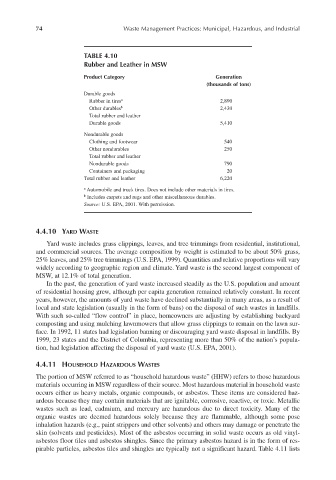
                                     TABLE 4.10
                                     Rubber and Leather in MSW

                                     Product Category                        Generation
                                                                          (thousands of tons)
                                     Durable goods
                                       Rubber in tires a                      2,890
                                       Other durables b                       2,430
                                       Total rubber and leather
                                       Durable goods                          5,410
                                     Nondurable goods
                                       Clothing and footwear                   540
                                       Other nondurables                       250
                                       Total rubber and leather
                                       Nondurable goods                        790
                                       Containers and packaging                 20
                                     Total rubber and leather                 6,220

                                     a  Automobile and truck tires. Does not include other materials in tires.
                                     b  Includes carpets and rugs and other miscellaneous durables.
                                     Source: U.S. EPA, 2001. With permission.


                       4.4.10 YARD WASTE

                          Yard waste includes grass clippings, leaves, and tree trimmings from residential, institutional,
                       and commercial sources. The average composition by weight is estimated to be about 50% grass,
                       25% leaves, and 25% tree trimmings (U.S. EPA, 1999). Quantities and relative proportions will vary
                       widely according to geographic region and climate. Yard waste is the second largest component of
                       MSW, at 12.1% of total generation.
                          In the past, the generation of yard waste increased steadily as the U.S. population and amount
                       of residential housing grew, although per capita generation remained relatively constant. In recent
                       years, however, the amounts of yard waste have declined substantially in many areas, as a result of
                       local and state legislation (usually in the form of bans) on the disposal of such wastes in landfills.
                       With such so-called “flow control” in place, homeowners are adjusting by establishing backyard
                       composting and using mulching lawnmowers that allow grass clippings to remain on the lawn sur-
                       face. In 1992, 11 states had legislation banning or discouraging yard waste disposal in landfills. By
                       1999, 23 states and the District of Columbia, representing more than 50% of the nation’s popula-
                       tion, had legislation affecting the disposal of yard waste (U.S. EPA, 2001).


                       4.4.11 HOUSEHOLD HAZARDOUS WASTES
                       The portion of MSW referred to as “household hazardous waste” (HHW) refers to those hazardous
                       materials occurring in MSW regardless of their source. Most hazardous material in household waste
                       occurs either as heavy metals, organic compounds, or asbestos. These items are considered haz-
                       ardous because they may contain materials that are ignitable, corrosive, reactive, or toxic. Metallic
                       wastes such as lead, cadmium, and mercury are hazardous due to direct toxicity. Many of the
                       organic wastes are deemed hazardous solely because they are flammable, although some pose
                       inhalation hazards (e.g., paint strippers and other solvents) and others may damage or penetrate the
                       skin (solvents and pesticides). Most of the asbestos occurring in solid waste occurs as old vinyl-
                       asbestos floor tiles and asbestos shingles. Since the primary asbestos hazard is in the form of res-
                       pirable particles, asbestos tiles and shingles are typically not a significant hazard. Table 4.11 lists

