


Page 100 - Materials Chemistry, Second Edition
P. 100
CAT3525_C04.qxd  1/27/2005  11:12 AM  Page 71
                       Characterization of Solid Waste                                              71

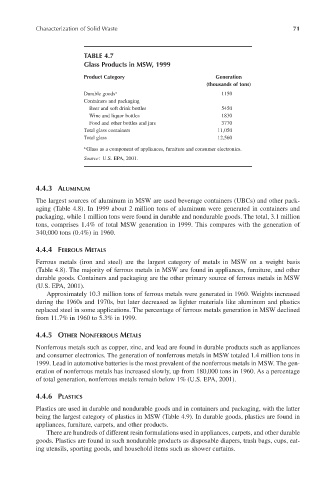
                                     TABLE 4.7
                                     Glass Products in MSW, 1999

                                     Product Category                        Generation
                                                                          (thousands of tons)
                                     Durable goods a                          1150
                                     Containers and packaging
                                       Beer and soft drink bottles            5450
                                       Wine and liquor bottles                1830
                                       Food and other bottles and jars        3770
                                     Total glass containers                  11,050
                                     Total glass                             12,560
                                     a  Glass as a component of appliances, furniture and consumer electronics.
                                     Source: U.S. EPA, 2001.


                       4.4.3 ALUMINUM

                       The largest sources of aluminum in MSW are used beverage containers (UBCs) and other pack-
                       aging (Table 4.8). In 1999 about 2 million tons of aluminum were generated in containers and
                       packaging, while 1 million tons were found in durable and nondurable goods. The total, 3.1 million
                       tons, comprises 1.4% of total MSW generation in 1999. This compares with the generation of
                       340,000 tons (0.4%) in 1960.

                       4.4.4 FERROUS METALS
                       Ferrous metals (iron and steel) are the largest category of metals in MSW on a weight basis
                       (Table 4.8). The majority of ferrous metals in MSW are found in appliances, furniture, and other
                       durable goods. Containers and packaging are the other primary source of ferrous metals in MSW
                       (U.S. EPA, 2001).
                          Approximately 10.3 million tons of ferrous metals were generated in 1960. Weights increased
                       during the 1960s and 1970s, but later decreased as lighter materials like aluminum and plastics
                       replaced steel in some applications. The percentage of ferrous metals generation in MSW declined
                       from 11.7% in 1960 to 5.3% in 1999.

                       4.4.5 OTHER NONFERROUS METALS
                       Nonferrous metals such as copper, zinc, and lead are found in durable products such as appliances
                       and consumer electronics. The generation of nonferrous metals in MSW totaled 1.4 million tons in
                       1999. Lead in automotive batteries is the most prevalent of the nonferrous metals in MSW. The gen-
                       eration of nonferrous metals has increased slowly, up from 180,000 tons in 1960. As a percentage
                       of total generation, nonferrous metals remain below 1% (U.S. EPA, 2001).


                       4.4.6 PLASTICS
                       Plastics are used in durable and nondurable goods and in containers and packaging, with the latter
                       being the largest category of plastics in MSW (Table 4.9). In durable goods, plastics are found in
                       appliances, furniture, carpets, and other products.
                          There are hundreds of different resin formulations used in appliances, carpets, and other durable
                       goods. Plastics are found in such nondurable products as disposable diapers, trash bags, cups, eat-
                       ing utensils, sporting goods, and household items such as shower curtains.

