


Page 101 - Materials Chemistry, Second Edition
P. 101
CAT3525_C04.qxd  1/27/2005  11:12 AM  Page 72
                       72                        Waste Management Practices: Municipal, Hazardous, and Industrial

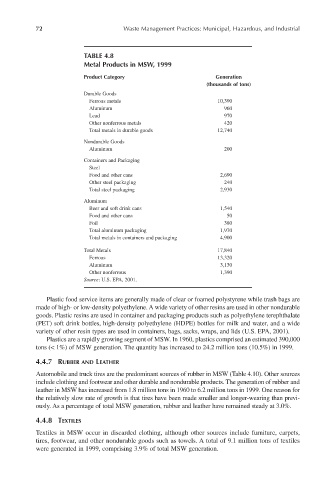
                                     TABLE 4.8
                                     Metal Products in MSW, 1999

                                     Product Category                        Generation
                                                                          (thousands of tons)
                                     Durable Goods
                                       Ferrous metals                        10,390
                                       Aluminum                                960
                                       Lead                                    970
                                       Other nonferrous metals                 420
                                       Total metals in durable goods         12,740
                                     Nondurable Goods
                                       Aluminum                                200
                                     Containers and Packaging
                                       Steel
                                       Food and other cans                    2,690
                                       Other steel packaging                   240
                                       Total steel packaging                  2,930
                                     Aluminum
                                       Beer and soft drink cans               1,540
                                       Food and other cans                      50
                                       Foil                                    380
                                       Total aluminum packaging               1,970
                                       Total metals in containers and packaging  4,900
                                     Total Metals                            17,840
                                       Ferrous                               13,320
                                       Aluminum                               3,130
                                       Other nonferrous                       1,390
                                     Source: U.S. EPA, 2001.

                          Plastic food service items are generally made of clear or foamed polystyrene while trash bags are
                       made of high- or low-density polyethylene. A wide variety of other resins are used in other nondurable
                       goods. Plastic resins are used in container and packaging products such as polyethylene terephthalate
                       (PET) soft drink bottles, high-density polyethylene (HDPE) bottles for milk and water, and a wide
                       variety of other resin types are used in containers, bags, sacks, wraps, and lids (U.S. EPA, 2001).
                          Plastics are a rapidly growing segment of MSW. In 1960, plastics comprised an estimated 390,000
                       tons (< 1%) of MSW generation. The quantity has increased to 24.2 million tons (10.5%) in 1999.

                       4.4.7 RUBBER AND LEATHER
                       Automobile and truck tires are the predominant sources of rubber in MSW (Table 4.10). Other sources
                       include clothing and footwear and other durable and nondurable products. The generation of rubber and
                       leather in MSW has increased from 1.8 million tons in 1960 to 6.2 million tons in 1999. One reason for
                       the relatively slow rate of growth is that tires have been made smaller and longer-wearing than previ-
                       ously. As a percentage of total MSW generation, rubber and leather have remained steady at 3.0%.

                       4.4.8 TEXTILES
                       Textiles in MSW occur in discarded clothing, although other sources include furniture, carpets,
                       tires, footwear, and other nondurable goods such as towels. A total of 9.1 million tons of textiles
                       were generated in 1999, comprising 3.9% of total MSW generation.

