


Page 111 - Wind Energy Handbook
P. 111
THE EFFECTS OF A DISCRETE NUMBER OF BLADES                              85


             R W   r is a distance measured from the wake edge. Distance d between the discs
             should be that of the distance travelled by particle three between successive vortex
             sheets. Glauert (1935) takes d as being the normal distance between successive
             helicoidcal vortex sheets.
               The helix angle of the vortex sheets is the flow angle ö S and so with N sheets
             intertwining from N blades

                                      2ðR W         2ðR W U 1 (1   a)
                                  d ¼       sin ö S ¼                             (3:75)
                                        N            N      W S
             Prandtl’s model has no wake rotation but the discs may spin at the rotor speed
             without affecting the flow at all, as it is inviscid, thus a9 is zero and W S is the
             resultant velocity (not including the radial velocity) at the edge of a disc. Glauert
             (1935a) argues that R W =W S   r=W which is much more convenient to use.
                                          p ffiffiffiffiffiffiffiffiffiffiffiffiffiffiffiffiffiffiffiffiffiffiffiffiffiffiffiffiffiffiffiffiffiffiffiffiffiffiffiffiffiffiffiffi
                                                      2
                                      W ¼   [U 1 (1   a)] þ (Ùr) 2
             so
                                                      s ffiffiffiffiffiffiffiffiffiffiffiffiffiffiffiffiffiffiffiffiffiffiffiffiffiffiffiffiffiffiffiffiffiffiffi
                                 R W   r    N  R   r          (Ùr) 2
                              ð          ¼             1 þ
                                    r       2    d         [U 1 (1   a)] 2
             and

                                                       p ffiffiffiffiffiffiffiffiffiffiffiffiffiffiffiffiffiffiffiffiffiffiffiffi
                                       2                     2    2
                                 f(ì) ¼  cos[e ((N=2)(1 ì)=ì)  1þ(ºì) =(1 a)  ]   (3:76)
                                       ð
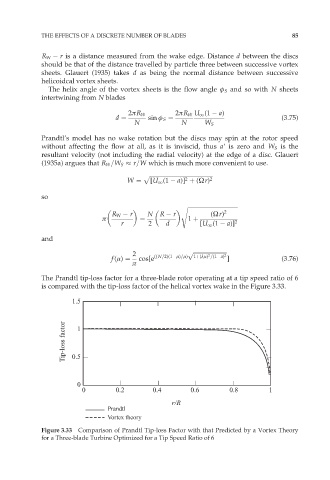
             The Prandtl tip-loss factor for a three-blade rotor operating at a tip speed ratio of 6
             is compared with the tip-loss factor of the helical vortex wake in the Figure 3.33.

                      1.5


                    Tip-loss factor  0.5
                       1


                       0
                         0           0.2              0.4        0.6               0.8          1
                                                   r/R
                                Prandtl
                                Vortex theory
             Figure 3.33  Comparison of Prandtl Tip-loss Factor with that Predicted by a Vortex Theory
             for a Three-blade Turbine Optimized for a Tip Speed Ratio of 6

