


Page 225 - Advanced Organic Chemistry Part A - Structure and Mechanisms, 5th ed (2007) - Carey _ Sundberg
P. 225
can be expressed in terms of the free-energy differences resulting from the individual  205
          preferences   G ∗  and   G ∗  plus any incremental change resulting from the combi-
                         1         2
          nation  G ∗  .                                                                  SECTION 2.6
                    12
                                                                                              Double
                                                                                      Stereodifferentiation:
                                                     ∗
                                             ∗
                               G ∗  matched  =  G +  G + G  ∗  12                        Reinforcing and
                                              1
                                                      2
                                                                                            Competing
                                                     ∗
                                             ∗
                              G ∗ mismatched  =  G −  G + G ∗  12                        Stereoselectivity
                                                      2
                                              1
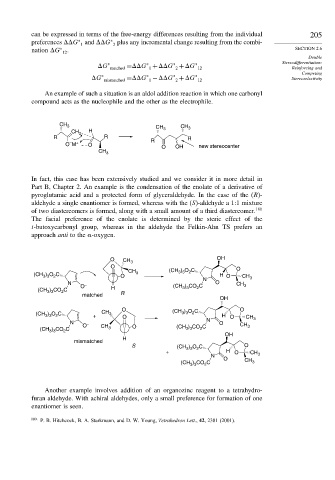
              An example of such a situation is an aldol addition reaction in which one carbonyl
          compound acts as the nucleophile and the other as the electrophile.
                   CH 3                                CH
                                                CH 3      3
                      CH 2  H
                 R              R             R          R
                      –
                     O M +  O                     O   OH     new stereocenter
                               CH 3
          In fact, this case has been extensively studied and we consider it in more detail in
          Part B, Chapter 2. An example is the condensation of the enolate of a derivative of
          pyroglutamic acid and a protected form of glyceraldehyde. In the case of the (R)-
          aldehyde a single enantiomer is formed, whereas with the (S)-aldehyde a 1:1 mixture
          of two diastereomers is formed, along with a small amount of a third diastereomer. 180
          The facial preference of the enolate is determined by the steric effect of the
          t-butoxycarbonyl group, whereas in the aldehyde the Felkin-Ahn TS prefers an
          approach anti to the  -oxygen.


                                  O   CH 3                        OH
                                  O                                     O
                                        CH          (CH ) O C
                                                          2
                                                       3 3
           (CH ) O C                 O    3                        H  O   CH
                 2
              3 3
                                                              N             3
                     N   O –                            ) CO C    O     CH 3
            (CH ) CO C            H                  (CH 3 3  2
               3 3
                   2
                          matched    R
                                                                   OH
                                      O              (CH ) O C           O
            (CH ) O C        +  CH 3  O                 3 3  2      H  O   CH
               3 3
                  2
                      N                                        N   O         3
                          O –  CH        O            (CH ) CO C         CH 3
             (CH ) CO C           3                      3 3  2
                3 3
                    2
                                                                     OH
                                      H
                       mismatched
                                         S            (CH ) O C           O
                                                            2
                                                         3 3
                                                   +                 H  O   CH
                                                                N             3
                                                                    O     CH
                                                           ) CO C            3
                                                       (CH 3 3  2
              Another example involves addition of an organozinc reagent to a tetrahydro-
          furan aldehyde. With achiral aldehydes, only a small preference for formation of one
          enantiomer is seen.
          180
             P. B. Hitchcock, B. A. Starkmann, and D. W. Young, Tetrahedron Lett., 42, 2381 (2001).

