


Page 226 - Advanced Organic Chemistry Part A - Structure and Mechanisms, 5th ed (2007) - Carey _ Sundberg
P. 226
206                                                     OH             OH
                                        IZn
     CHAPTER 2                                             R              R
                                                       BF         O  O           O   O
     Stereochemistry,       RCH   O  +        O   O      3
     Conformation,                                                        +      CH CH
     and Stereoselectivity                   CH CH 3             CH 3  CH 3        3   3
                                                3
                                               S                   R        Product Ratio
                                                                  C H          73:27
                                                                   2 5
                                                                  (CH ) CH     76:24
                                                                     3 2
                                                                  Phenyl       76:24
                                                                  S-A          73:27


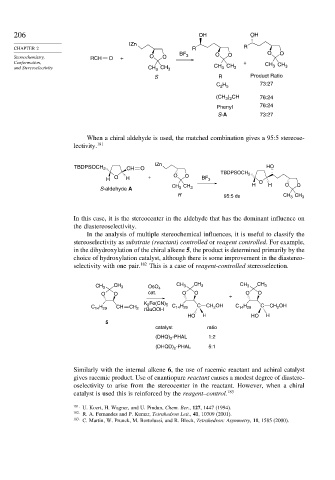
                           When a chiral aldehyde is used, the matched combination gives a 95:5 stereose-
                       lectivity. 181

                                                IZn
                       TBDPSOCH 2      CH  O                                     HO
                                                                   TBDPSOCH 2
                                 H  O  H      +      O   O    BF 3             O
                                                        CH                   H    H    O  O
                               S-aldehyde A          CH 3  3
                                                      R             95:5 ds           CH 3  CH 3


                       In this case, it is the stereocenter in the aldehyde that has the dominant influence on
                       the diastereoselectivity.
                           In the analysis of multiple stereochemical influences, it is useful to classify the
                       stereoselectivity as substrate (reactant) controlled or reagent controlled. For example,
                       in the dihydroxylation of the chiral alkene 5, the product is determined primarily by the
                       choice of hydroxylation catalyst, although there is some improvement in the diastereo-
                       selectivity with one pair. 182  This is a case of reagent-controlled stereoselection.


                              CH 3  CH 3      OsO 4   CH 3  CH 3         CH 3  CH 3
                               O   O          cat.      O  O               O  O
                                                                      +
                                            K 2 Fe(CN) 5    C  CH 2 OH         C  CH 2 OH
                            C 14 H 29  CH  CH 2      C 14 H 29          C 14 H 29
                                            t BuOOH
                                                         HO   H             HO   H
                                 5
                                                catalyst       ratio
                                                (DHQ) 2 -PHAL   1:2
                                                (DHQD) 2 -PHAL  5:1


                       Similarly with the internal alkene 6, the use of racemic reactant and achiral catalyst
                       gives racemic product. Use of enantiopure reactant causes a modest degree of diastere-
                       oselectivity to arise from the stereocenter in the reactant. However, when a chiral
                       catalyst is used this is reinforced by the reagent–control. 183

                       181
                          U. Koert, H. Wagner, and U. Pindun, Chem. Ber., 127, 1447 (1994).
                       182	  R. A. Fernandes and P. Kumar, Tetrahedron Lett., 41, 10309 (2001).
                       183
                          C. Martin, W. Prunck, M. Bortolussi, and R. Bloch, Tetrahedron: Asymmetry, 11, 1585 (2000).

