


Page 441 - Advanced Organic Chemistry Part A - Structure and Mechanisms, 5th ed (2007) - Carey _ Sundberg
P. 441
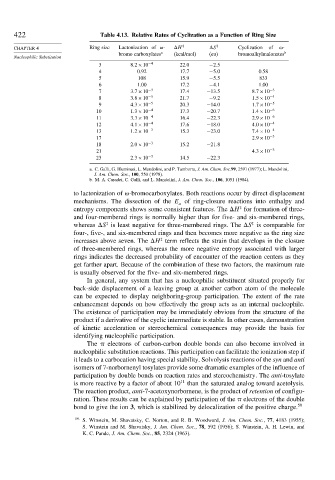
422                       Table 4.13. Relative Rates of Cyclization as a Function of Ring Size

     CHAPTER 4              Ring size  Lactonization of  -   H ‡   S  ‡  Cyclization  of   -
                                     bromo carboxylates a  (kcal/mol)  (eu)  bromoalkylmalonates b
     Nucleophilic Substitution
                               3        8 2×10 −4      22 0     −2 5
                               4          0.92         17 7     −5 0           0.58
                               5          108          15 9     −5 5           833
                               6          1.00         17 2     −4 1           1.00
                               7        3 7×10 −3      17 4    −13 5         8 7×10 −3
                               8        3 8×10 −5      21 7     −9 2         1 5×10 −4
                               9        4 3×10 −5      20 3    −14 0         1 7×10 −5
                              10        1 3×10 −4      17 3    −20 7         1 4×10 −6
                              11        3 3×10 −4      16 4    −22 3         2 9×10 −6
                              12        4 1×10 −4      17 6    −18 0         4 0×10 −4
                              13        1 2×10 −3      15 3    −23 0         7 4×10 −4
                              17                                             2 9×10 −3
                              18        2 0×10 −3      15 2    −21 8
                              21                                             4 3×10 −3
                              23        2 3×10 −3      14 5    −22 3
                            a. C. Galli, G. Illuminati, L. Mandolini, and P. Tamborra, J. Am. Chem. Soc.99, 2591 (1977); L. Mandolini,
                             J. Am. Chem. Soc., 100, 550 (1978).
                            b. M. A. Casadei, C. Galli, and L. Mandolini, J. Am. Chem. Soc., 106, 1051 (1984).

                       to lactonization of  -bromocarboxylates. Both reactions occur by direct displacement
                       mechanisms. The dissection of the E of ring-closure reactions into enthalpy and
                                                       a
                                                                         ‡
                       entropy components shows some consistent features. The  H for formation of three-
                       and four-membered rings is normally higher than for five- and six-membered rings,
                                 ‡
                                                                             ‡
                       whereas  S is least negative for three-membered rings. The  S is comparable for
                       four-, five-, and six-membered rings and then becomes more negative as the ring size
                                                 ‡
                       increases above seven. The  H term reflects the strain that develops in the closure
                       of three-membered rings, whereas the more negative entropy associated with larger
                       rings indicates the decreased probability of encounter of the reaction centers as they
                       get farther apart. Because of the combination of these two factors, the maximum rate
                       is usually observed for the five- and six-membered rings.
                           In general, any system that has a nucleophilic substituent situated properly for
                       back-side displacement of a leaving group at another carbon atom of the molecule
                       can be expected to display neighboring-group participation. The extent of the rate
                       enhancement depends on how effectively the group acts as an internal nucleophile.
                       The existence of participation may be immediately obvious from the structure of the
                       product if a derivative of the cyclic intermediate is stable. In other cases, demonstration
                       of kinetic acceleration or stereochemical consequences may provide the basis for
                       identifying nucleophilic participation.
                           The   electrons of carbon-carbon double bonds can also become involved in
                       nucleophilic substitution reactions. This participation can facilitate the ionization step if
                       it leads to a carbocation having special stability. Solvolysis reactions of the syn and anti
                       isomers of 7-norbornenyl tosylates provide some dramatic examples of the influence of
                       participation by double bonds on reaction rates and stereochemistry. The anti-tosylate
                       is more reactive by a factor of about 10 11  than the saturated analog toward acetolysis.
                       The reaction product, anti-7-acetoxynorbornene, is the product of retention of configu-
                       ration. These results can be explained by participation of the   electrons of the double
                       bond to give the ion 3, which is stabilized by delocalization of the positive charge. 59
                        59   S. Winstein, M. Shavatsky, C. Norton, and R. B. Woodward, J. Am. Chem. Soc., 77, 4183 (1955);
                          S. Winstein and M. Shavatsky, J. Am. Chem. Soc., 78, 592 (1956); S. Winstein, A. H. Lewin, and
                          K. C. Pande, J. Am. Chem. Soc., 85, 2324 (1963).

