


Page 442 - Advanced Organic Chemistry Part A - Structure and Mechanisms, 5th ed (2007) - Carey _ Sundberg
P. 442
OTs               δ − OTs                            O 2 CCH 3              423
                                δ +                +      CH 3 CO 2 H                     SECTION 4.3
                                                                                       Neighboring-Group
                                                                                          Participation
                                                  3


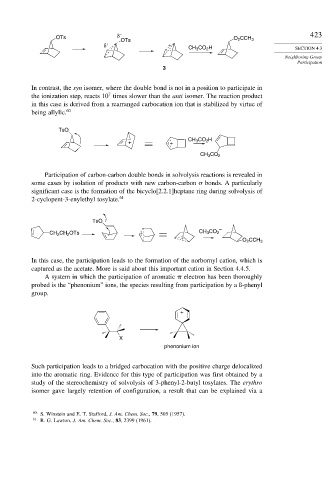
          In contrast, the syn isomer, where the double bond is not in a position to participate in
                                  7
          the ionization step, reacts 10 times slower than the anti isomer. The reaction product
          in this case is derived from a rearranged carbocation ion that is stabilized by virtue of
          being allylic. 60

                   TsO
                                                          CH 3 CO 2 H
                                        +           +
                                                             CH 3 CO 2

              Participation of carbon-carbon double bonds in solvolysis reactions is revealed in
          some cases by isolation of products with new carbon-carbon 	 bonds. A particularly
          significant case is the formation of the bicyclo[2.2.1]heptane ring during solvolysis of
          2-cyclopent-3-enylethyl tosylate. 61


                             TsO
                                                                   –
                CH CH OTs                  +                 CH 3 CO 2
                  2
                     2
                                                       +
                                                                          O 2 CCH 3
          In this case, the participation leads to the formation of the norbornyl cation, which is
          captured as the acetate. More is said about this important cation in Section 4.4.5.
              A system in which the participation of aromatic   electron has been thoroughly
          probed is the “phenonium” ions, the species resulting from participation by a ß-phenyl
          group.


                                                       +


                                     X
                                                  phenonium ion


          Such participation leads to a bridged carbocation with the positive charge delocalized
          into the aromatic ring. Evidence for this type of participation was first obtained by a
          study of the stereochemistry of solvolysis of 3-phenyl-2-butyl tosylates. The erythro
          isomer gave largely retention of configuration, a result that can be explained via a


           60   S. Winstein and E. T. Stafford, J. Am. Chem. Soc., 79, 505 (1957).
           61
             R. G. Lawton, J. Am. Chem. Soc., 83, 2399 (1961).

