


Page 308 - Advances in Renewable Energies and Power Technologies
P. 308
4. Energy Management      281


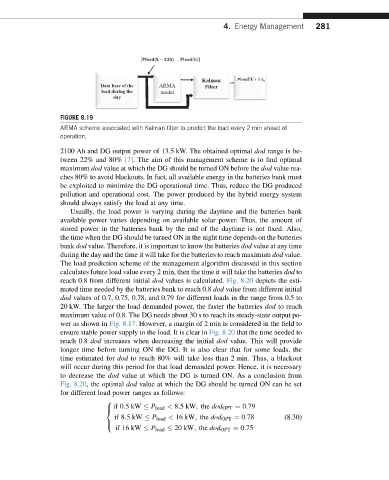
                                                         Kalman
                             Data base of the  ARMA       Filter
                             load during the  model
                                day


                  FIGURE 8.19
                  ARMA scheme associated with Kalman filter to predict the load every 2 min ahead of
                  operation.

                  2100 Ah and DG output power of 13.5 kW. The obtained optimal dod range is be-
                  tween 22% and 80% [7]. The aim of this management scheme is to find optimal
                  maximum dod value at which the DG should be turned ON before the dod value rea-
                  ches 80% to avoid blackouts. In fact, all available energy in the batteries bank must
                  be exploited to minimize the DG operational time. Thus, reduce the DG produced
                  pollution and operational cost. The power produced by the hybrid energy system
                  should always satisfy the load at any time.
                     Usually, the load power is varying during the daytime and the batteries bank
                  available power varies depending on available solar power. Thus, the amount of
                  stored power in the batteries bank by the end of the daytime is not fixed. Also,
                  the time when the DG should be turned ON in the night time depends on the batteries
                  bank dod value. Therefore, it is important to know the batteries dod value at any time
                  during the day and the time it will take for the batteries to reach maximum dod value.
                  The load prediction scheme of the management algorithm discussed in this section
                  calculates future load value every 2 min, then the time it will take the batteries dod to
                  reach 0.8 from different initial dod values is calculated. Fig. 8.20 depicts the esti-
                  mated time needed by the batteries bank to reach 0.8 dod value from different initial
                  dod values of 0.7, 0.75, 0.78, and 0.79 for different loads in the range from 0.5 to
                  20 kW. The larger the load demanded power, the faster the batteries dod to reach
                  maximum value of 0.8. The DG needs about 30 s to reach its steady-state output po-
                  wer as shown in Fig. 8.17. However, a margin of 2 min is considered in the field to
                  ensure stable power supply to the load. It is clear in Fig. 8.20 that the time needed to
                  reach 0.8 dod increases when decreasing the initial dod value. This will provide
                  longer time before turning ON the DG. It is also clear that for some loads, the
                  time estimated for dod to reach 80% will take less than 2 min. Thus, a blackout
                  will occur during this period for that load demanded power. Hence, it is necessary
                  to decrease the dod value at which the DG is turned ON. As a conclusion from
                  Fig. 8.20, the optimal dod value at which the DG should be turned ON can be set
                  for different load power ranges as follows:
                              8
                              > if 0:5kW   P load < 8:5kW; the dod OPT ¼ 0:79
                              <
                                 if 8:5kW   P load < 16 kW; the dod OPT ¼ 0:78  (8.30)
                              >
                                 if 16 kW   P load   20 kW; the dod OPT ¼ 0:75
                              :

