


Page 310 - Advances in Renewable Energies and Power Technologies
P. 310
4. Energy Management      283


                     The calculated forecasted error of the investigated load equals to about 0.2%. At
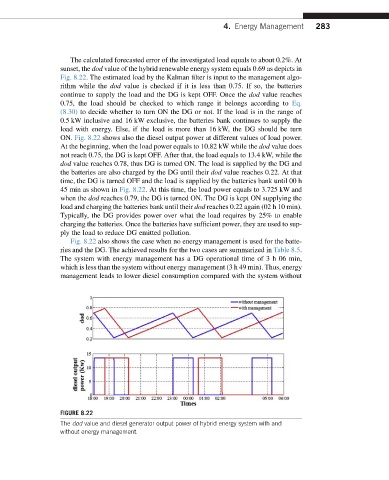
                  sunset, the dod value of the hybrid renewable energy system equals 0.69 as depicts in
                  Fig. 8.22. The estimated load by the Kalman filter is input to the management algo-
                  rithm while the dod value is checked if it is less than 0.75. If so, the batteries
                  continue to supply the load and the DG is kept OFF. Once the dod value reaches
                  0.75, the load should be checked to which range it belongs according to Eq.
                  (8.30) to decide whether to turn ON the DG or not. If the load is in the range of
                  0.5 kW inclusive and 16 kW exclusive, the batteries bank continues to supply the
                  load with energy. Else, if the load is more than 16 kW, the DG should be turn
                  ON. Fig. 8.22 shows also the diesel output power at different values of load power.
                  At the beginning, when the load power equals to 10.82 kW while the dod value does
                  not reach 0.75, the DG is kept OFF. After that, the load equals to 13.4 kW, while the
                  dod value reaches 0.78, thus DG is turned ON. The load is supplied by the DG and
                  the batteries are also charged by the DG until their dod value reaches 0.22. At that
                  time, the DG is turned OFF and the load is supplied by the batteries bank until 00 h
                  45 min as shown in Fig. 8.22. At this time, the load power equals to 3.725 kW and
                  when the dod reaches 0.79, the DG is turned ON. The DG is kept ON supplying the
                  load and charging the batteries bank until their dod reaches 0.22 again (02 h 10 min).
                  Typically, the DG provides power over what the load requires by 25% to enable
                  charging the batteries. Once the batteries have sufficient power, they are used to sup-
                  ply the load to reduce DG emitted pollution.
                     Fig. 8.22 also shows the case when no energy management is used for the batte-
                  ries and the DG. The achieved results for the two cases are summarized in Table 8.5.
                  The system with energy management has a DG operational time of 3 h 06 min,
                  which is less than the system without energy management (3 h 49 min). Thus, energy
                  management leads to lower diesel consumption compared with the system without


                  FIGURE 8.22
                  The dod value and diesel generator output power of hybrid energy system with and
                  without energy management.

