


Page 314 - Advances in Renewable Energies and Power Technologies
P. 314
5. Economics of Hybrid PV/Batteries Bank/Diesel Generator System   287


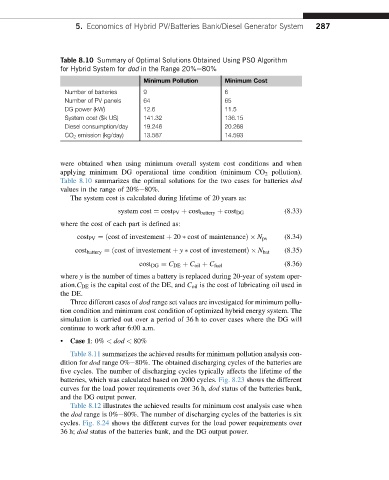
                  Table 8.10 Summary of Optimal Solutions Obtained Using PSO Algorithm
                  for Hybrid System for dod in the Range 20%e80%
                                         Minimum Pollution     Minimum Cost
                   Number of batteries   9                     6
                   Number of PV panels   64                    65
                   DG power (kW)         12.6                  11.5
                   System cost ($k US)   141.32                136.15
                   Diesel consumption/day  19.246              20.268
                   CO 2 emission (kg/day)  13.587              14.593


                  were obtained when using minimum overall system cost conditions and when
                  applying minimum DG operational time condition (minimum CO 2 pollution).
                  Table 8.10 summarizes the optimal solutions for the two cases for batteries dod
                  values in the range of 20%e80%.
                     The system cost is calculated during lifetime of 20 years as:
                                  system cost ¼ cost PV þ cost battery þ cost DG  (8.33)
                  where the cost of each part is defined as:
                                                                                (8.34)
                      cost PV ¼ðcost of investement þ 20   cost of maintenanceÞ  N pv
                      cost battery ¼ðcost of investement þ y   cost of investementÞ  N bat  (8.35)

                                        cost DG ¼ C DE þ C oil þ C fuel         (8.36)
                  where y is the number of times a battery is replaced during 20-year of system oper-
                  ation.C DE is the capital cost of the DE, and C oil is the cost of lubricating oil used in
                  the DE.
                     Three different cases of dod range set values are investigated for minimum pollu-
                  tion condition and minimum cost condition of optimized hybrid energy system. The
                  simulation is carried out over a period of 36 h to cover cases where the DG will
                  continue to work after 6:00 a.m.

                  •  Case 1:0% < dod < 80%
                     Table 8.11 summarizes the achieved results for minimum pollution analysis con-
                  dition for dod range 0%e80%. The obtained discharging cycles of the batteries are
                  five cycles. The number of discharging cycles typically affects the lifetime of the
                  batteries, which was calculated based on 2000 cycles. Fig. 8.23 shows the different
                  curves for the load power requirements over 36 h, dod status of the batteries bank,
                  and the DG output power.
                     Table 8.12 illustrates the achieved results for minimum cost analysis case when
                  the dod range is 0%e80%. The number of discharging cycles of the batteries is six
                  cycles. Fig. 8.24 shows the different curves for the load power requirements over
                  36 h; dod status of the batteries bank, and the DG output power.

