


Page 428 -
P. 428
408   CHAPTER 10 INVENTORY MODELS


                                     inventory. Such costs are usually fixed regardless of the actual amount ordered and
                                     are usually expressed as a cost per order placed, E30 per order for example. The
                                     order cost itself is typically made up of staff costs of those involved in raising the
                                     order, receiving and checking the order, paying invoices; postage and phone costs;
                                     transportation and shipping costs.
                                       The third type of cost is known as the stockout cost. This is the cost involved
                                     when customer demand cannot be met because of insufficient inventory. The imme-
                                     diate cost may be that involved in obtaining additional inventory as a matter of
                                     urgency to meet demand. In the medium to long term such costs may also involve
                                     loss of customer goodwill, loss of future sales and loss of future profit – although
                                     these are notoriously difficult to quantify accurately. As a result, stockout costs are
                                     often an educated ‘best guess’.
                                       The prime purpose of effective inventory management is to minimize these costs
                                     by determining the optimum amount of inventory that should be held and ordered
                                     and when inventory should be ordered. In the next section we introduce the most
                                     common model used in inventory management.


                              10.2    Economic Order Quantity (EOQ) Model


                    The cost associated with  The economic order quantity (EOQ) model is applicable when the demand for an
                    developing and   item shows a constant, or nearly constant, rate and when the entire quantity
                    maintaining inventory is
                    larger than many people  ordered arrives in inventory at one time. The constant demand rate assumption
                    think. Models such as  means that the same number of units is taken from inventory each period of time
                    the ones presented in  such as five units every day, 25 units every week, 100 units every four-week period
                    this chapter can be used  and so on.
                    to develop cost-effective
                    inventory management  To illustrate the EOQ model, let us consider the situation faced by the Capetown
                    decisions.       Beverage Company (CBC) in South Africa. CBC is a distributor of soft drink
                                     products. From a main warehouse CBC supplies nearly 1000 small retail stores with
                                     beverage products.
                                       The warehouse manager has decided to conduct a detailed study of the inventory
                                     costs associated with Cape Cola, the number-one-selling CBC soft drink. The
                                     purpose of the study is to establish the how-much-to-order and the when-to-order
                                     decisions for Cape Cola that will result in the lowest possible total inventory cost. As
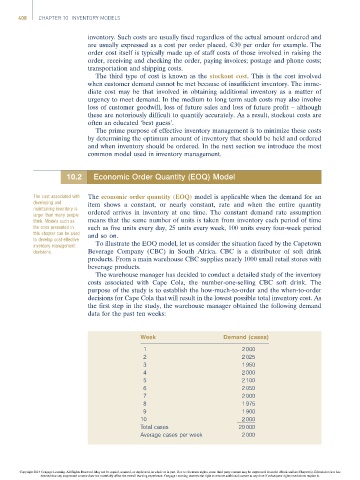
                                     the first step in the study, the warehouse manager obtained the following demand
                                     data for the past ten weeks:


                                                     Week                     Demand (cases)
                                                      1                             2 000
                                                      2                             2 025
                                                      3                             1 950
                                                      4                             2 000
                                                      5                             2 100
                                                      6                             2 050
                                                      7                             2 000
                                                      8                             1 975
                                                      9                             1 900
                                                     10                             2 000
                                                     Total cases                   20 000
                                                     Average cases per week         2 000


                Copyright 2014 Cengage Learning. All Rights Reserved. May not be copied, scanned, or duplicated, in whole or in part. Due to electronic rights, some third party content may be suppressed from the eBook and/or eChapter(s). Editorial review has
                      deemed that any suppressed content does not materially affect the overall learning experience. Cengage Learning reserves the right to remove additional content at any time if subsequent rights restrictions require it.

