


Page 523 -
P. 523
RISK ANALYSIS  503


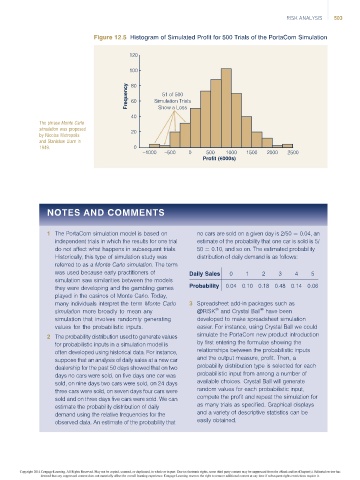
                                      Figure 12.5 Histogram of Simulated Profit for 500 Trials of the PortaCom Simulation

                                                 120

                                                 100

                                                 Frequency  80  Simulation Trials
                                                           51 of 500
                                                  60

                                                  40      Show a Loss
                      The phrase Monte Carlo
                      simulation was proposed     20
                      by Nicolas Metropolis
                      and Stanislaw Ulam in
                      1949.                        0
                                                      1000   500    0    500   1000  1500   2000  2500
                                                                        Profit (€000s)


                        NOTES AND COMMENTS


                        1 The PortaCom simulation model is based on   no cars are sold on a given day is 2/50 ¼ 0.04, an
                          independent trials in which the results for one trial  estimate of the probability that one car is sold is 5/
                          do not affect what happens in subsequent trials.  50 ¼ 0.10, and so on. The estimated probability
                          Historically, this type of simulation study was  distribution of daily demand is as follows:
                          referred to as a Monte Carlo simulation. The term
                          was used because early practitioners of   Daily Sales  0   1    2    3    4    5
                          simulation saw similarities between the models
                          they were developing and the gambling games  Probability  0.04 0.10 0.18 0.48 0.14 0.06
                          played in the casinos of Monte Carlo. Today,
                          many individuals interpret the term Monte Carlo  3 Spreadsheet add-in packages such as
                                                                            Ò
                                                                                         Ò
                          simulation more broadly to mean any         @RISK and Crystal Ball have been
                          simulation that involves randomly generating  developed to make spreadsheet simulation
                          values for the probabilistic inputs.        easier. For instance, using Crystal Ball we could
                        2 The probability distribution used to generate values  simulate the PortaCom new product introduction
                          for probabilistic inputs in a simulation model is  by first entering the formulae showing the
                          often developed using historical data. For instance,  relationships between the probabilistic inputs
                          suppose that an analysis of daily sales at a new car  and the output measure, profit. Then, a
                          dealership for the past 50 days showed that on two  probability distribution type is selected for each
                          days no cars were sold, on five days one car was  probabilistic input from among a number of
                          sold, on nine days two cars were sold, on 24 days  available choices. Crystal Ball will generate
                          three cars were sold, on seven days four cars were  random values for each probabilistic input,
                                                                      compute the profit and repeat the simulation for
                          sold and on three days five cars were sold. We can
                                                                      as many trials as specified. Graphical displays
                          estimate the probability distribution of daily
                                                                      and a variety of descriptive statistics can be
                          demand using the relative frequencies for the
                                                                      easily obtained.
                          observed data. An estimate of the probability that


                Copyright 2014 Cengage Learning. All Rights Reserved. May not be copied, scanned, or duplicated, in whole or in part. Due to electronic rights, some third party content may be suppressed from the eBook and/or eChapter(s). Editorial review has
                      deemed that any suppressed content does not materially affect the overall learning experience. Cengage Learning reserves the right to remove additional content at any time if subsequent rights restrictions require it.

