


Page 234 - Biomedical Engineering and Design Handbook Volume 1, Fundamentals
P. 234
BIODYNAMICS: A LAGRANGIAN APPROACH  211

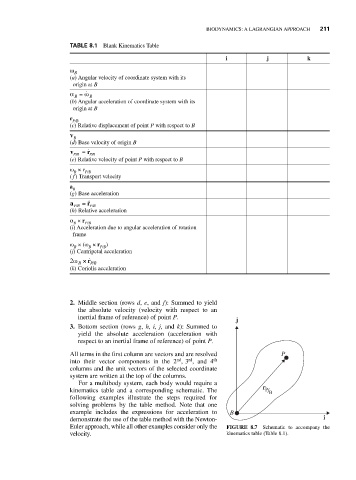
                          TABLE 8.1  Blank Kinematics Table
                                                                     i          j          k
                          ω B
                          (a) Angular velocity of coordinate system with its
                          origin at B
                          α =
                              ω
                           B   B
                          (b) Angular acceleration of coordinate system with its
                          origin at B
                          r
                          P/B
                          (c) Relative displacement of point P with respect to B
                          V
                           B
                          (d) Base velocity of origin B
                          v  =  r
                                /
                           /
                           PB  PB
                          (e) Relative velocity of point P with respect to B
                          ω × r
                           B  P/B
                          ( f ) Transport velocity
                          a
                          B
                          (g) Base acceleration
                          a  =  r
                           /
                                /
                           PB  PB
                          (h) Relative acceleration
                          α × r
                           B  P/B
                          (i) Acceleration due to angular acceleration of rotation
                          frame
                          ω × (ω × r  )
                           B   B  P/B
                          (j) Centripetal acceleration
                          2ω ×   r P B
                            B
                                /
                          (k) Coriolis acceleration
                          2. Middle section (rows d, e, and f): Summed to yield
                            the absolute velocity (velocity with respect to an
                            inertial frame of reference) of point P.    j
                          3. Bottom section (rows g, h, i, j, and k): Summed to
                            yield the absolute acceleration (acceleration with
                            respect to an inertial frame of reference) of point P.
                          All terms in the first column are vectors and are resolved  P
                                                           rd
                                                       nd
                          into their vector components in the 2 ,3 , and 4 th
                          columns and the unit vectors of the selected coordinate
                          system are written at the top of the columns.
                            For a multibody system, each body would require a
                          kinematics table and a corresponding schematic.  The  r P / B
                          following examples illustrate the steps required for
                          solving problems by the table method. Note that one
                          example includes the expressions for acceleration to  B
                          demonstrate the use of the table method with the Newton-              i
                          Euler approach, while all other examples consider only the  FIGURE 8.7  Schematic to accompany the
                          velocity.                                  kinematics table (Table 8.1).

