


Page 198 -
P. 198
5.1 / SEMICONDUCTOR MAIN MEMORY 167

                       logic connected to the higher-order bits of the address bus (i.e., address bits
                       above A19).The use of this signal is illustrated presently.
                     • A program voltage (V ) that is supplied during programming (write operations).
                                         pp
                       A typical DRAM pin configuration is shown in Figure 5.4b, for a 16-Mbit chip
                  organized as 4M *  4. There are several differences from a ROM chip. Because a
                  RAM can be updated, the data pins are input/output. The write enable (WE) and
                  output enable (OE) pins indicate whether this is a write or read operation. Because
                  the DRAM is accessed by row and column, and the address is multiplexed, only 11
                  address pins are needed to specify the 4M row/column combinations (2 11  *  2 11  =
                  2 22  =  4M). The functions of the row address select (RAS) and column address se-
                  lect (CAS) pins were discussed previously. Finally, the no connect (NC) pin is pro-
                  vided so that there are an even number of pins.

                  Module Organization
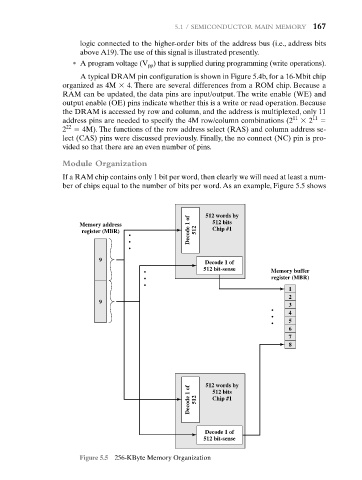
                  If a RAM chip contains only 1 bit per word, then clearly we will need at least a num-
                  ber of chips equal to the number of bits per word. As an example, Figure 5.5 shows


                                                           512 bits
                       Memory address                    512 words by
                       register (MBR)                Decode 1 of  512  Chip #1
                                    •
                                    •
                                    •
                            9
                                                         Decode 1 of
                                                         512 bit-sense
                                        •                                  Memory buffer
                                        •                                  register (MBR)
                                        •
                                                                                1
                                                                                2
                            9
                                                                                3
                                                                           •    4
                                                                           •
                                                                           •    5
                                                                                6
                                                                                7
                                                                                8


                                                         512 words by
                                                     Decode 1 of  512  Chip #1
                                                           512 bits


                                                         Decode 1 of
                                                         512 bit-sense


                       Figure 5.5  256-KByte Memory Organization

