


Page 201 -
P. 201
170  CHAPTER 5 / INTERNAL MEMORY

                               (a)   A       B         (b)


                                         1                        1
                                                            1          0
                                         1                        1
                                      1     0                 1      0
                                                                  0


                                         C
                               (c)                     (d)

                                         1                        1
                                    1         0             1          0
                                         1                        1
                                      0     0                 0      0
                                         0                        0


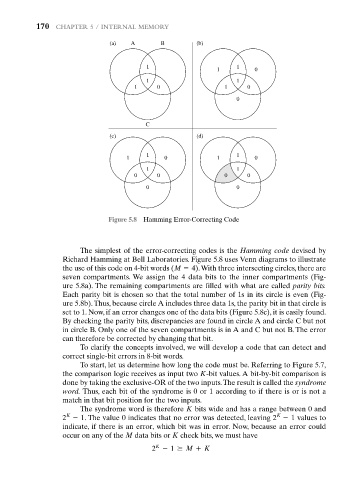
                               Figure 5.8 Hamming Error-Correcting Code


                       The simplest of the error-correcting codes is the Hamming code devised by
                  Richard Hamming at Bell Laboratories. Figure 5.8 uses Venn diagrams to illustrate
                  the use of this code on 4-bit words (M =  4).With three intersecting circles, there are
                  seven compartments. We assign the 4 data bits to the inner compartments (Fig-
                  ure 5.8a). The remaining compartments are filled with what are called parity bits.
                  Each parity bit is chosen so that the total number of 1s in its circle is even (Fig-
                  ure 5.8b).Thus, because circle A includes three data 1s, the parity bit in that circle is
                  set to 1. Now, if an error changes one of the data bits (Figure 5.8c), it is easily found.
                  By checking the parity bits, discrepancies are found in circle A and circle C but not
                  in circle B. Only one of the seven compartments is in A and C but not B. The error
                  can therefore be corrected by changing that bit.
                       To clarify the concepts involved, we will develop a code that can detect and
                  correct single-bit errors in 8-bit words.
                       To start, let us determine how long the code must be. Referring to Figure 5.7,
                  the comparison logic receives as input two K-bit values. A bit-by-bit comparison is
                  done by taking the exclusive-OR of the two inputs.The result is called the syndrome
                  word. Thus, each bit of the syndrome is 0 or 1 according to if there is or is not a
                  match in that bit position for the two inputs.
                       The syndrome word is therefore K bits wide and has a range between 0 and
                                                                             K
                  2 -  1. The value 0 indicates that no error was detected, leaving 2 -  1 values to
                   K
                  indicate, if there is an error, which bit was in error. Now, because an error could
                  occur on any of the M data bits or K check bits, we must have
                                           2 K  - 1 Ú M + K

