


Page 205 -
P. 205
174  CHAPTER 5 / INTERNAL MEMORY

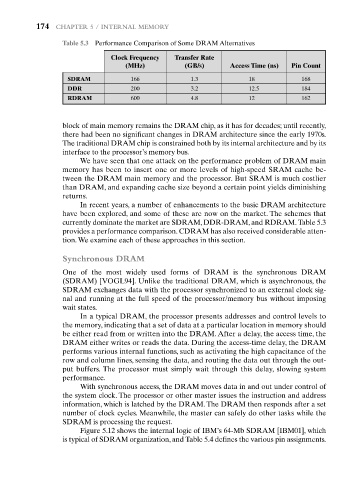
                  Table 5.3 Performance Comparison of Some DRAM Alternatives

                               Clock Frequency   Transfer Rate
                                   (MHz)           (GB/s)       Access Time (ns)  Pin Count
                   SDRAM             166             1.3             18            168
                   DDR               200             3.2             12.5          184
                    RDRAM            600             4.8             12            162


                  block of main memory remains the DRAM chip, as it has for decades; until recently,
                  there had been no significant changes in DRAM architecture since the early 1970s.
                  The traditional DRAM chip is constrained both by its internal architecture and by its
                  interface to the processor’s memory bus.
                       We have seen that one attack on the performance problem of DRAM main
                  memory has been to insert one or more levels of high-speed SRAM cache be-
                  tween the DRAM main memory and the processor. But SRAM is much costlier
                  than DRAM, and expanding cache size beyond a certain point yields diminishing
                  returns.
                       In recent years, a number of enhancements to the basic DRAM architecture
                  have been explored, and some of these are now on the market. The schemes that
                  currently dominate the market are SDRAM, DDR-DRAM, and RDRAM. Table 5.3
                  provides a performance comparison. CDRAM has also received considerable atten-
                  tion.We examine each of these approaches in this section.

                  Synchronous DRAM
                  One of the most widely used forms of DRAM is the synchronous DRAM
                  (SDRAM) [VOGL94]. Unlike the traditional DRAM, which is asynchronous, the
                  SDRAM exchanges data with the processor synchronized to an external clock sig-
                  nal and running at the full speed of the processor/memory bus without imposing
                  wait states.
                       In a typical DRAM, the processor presents addresses and control levels to
                  the memory, indicating that a set of data at a particular location in memory should
                  be either read from or written into the DRAM. After a delay, the access time, the
                  DRAM either writes or reads the data. During the access-time delay, the DRAM
                  performs various internal functions, such as activating the high capacitance of the
                  row and column lines, sensing the data, and routing the data out through the out-
                  put buffers. The processor must simply wait through this delay, slowing system
                  performance.
                       With synchronous access, the DRAM moves data in and out under control of
                  the system clock. The processor or other master issues the instruction and address
                  information, which is latched by the DRAM. The DRAM then responds after a set
                  number of clock cycles. Meanwhile, the master can safely do other tasks while the
                  SDRAM is processing the request.
                       Figure 5.12 shows the internal logic of IBM’s 64-Mb SDRAM [IBM01], which
                  is typical of SDRAM organization, and Table 5.4 defines the various pin assignments.

