


Page 208 -
P. 208
176  CHAPTER 5 / INTERNAL MEMORY

                              Table 5.4 SDRAM Pin Assignments

                                A0 to A13                    Address inputs
                                CLK                          Clock input
                                CKE                          Clock enable
                                CS                           Chip select
                                RAS                          Row address strobe
                                CAS                          Column address strobe
                                WE                           Write enable
                                DQ0 to DQ7                   Data input/output
                                DQM                          Data mask


                  The SDRAM employs a burst mode to eliminate the address setup time and row and
                  column line precharge time after the first access. In burst mode, a series of data bits
                  can be clocked out rapidly after the first bit has been accessed. This mode is useful
                  when all the bits to be accessed are in sequence and in the same row of the array as
                  the initial access. In addition, the SDRAM has a multiple-bank internal architecture
                  that improves opportunities for on-chip parallelism.
                       The mode register and associated control logic is another key feature differen-
                  tiating SDRAMs from conventional DRAMs. It provides a mechanism to customize
                  the SDRAM to suit specific system needs. The mode register specifies the burst
                  length, which is the number of separate units of data synchronously fed onto the
                  bus. The register also allows the programmer to adjust the latency between receipt
                  of a read request and the beginning of data transfer.
                       The SDRAM performs best when it is transferring large blocks of data seri-
                  ally, such as for applications like word processing, spreadsheets, and multimedia.
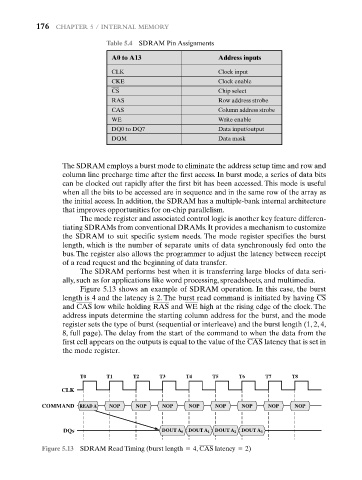
                       Figure 5.13 shows an example of SDRAM operation. In this case, the burst
                  length is 4 and the latency is 2. The burst read command is initiated by having CS
                  and CAS  low while holding RAS  and WE  high at the rising edge of the clock. The
                  address inputs determine the starting column address for the burst, and the mode
                  register sets the type of burst (sequential or interleave) and the burst length (1, 2, 4,
                  8, full page). The delay from the start of the command to when the data from the
                  first cell appears on the outputs is equal to the value of the CAS  latency that is set in
                  the mode register.


                       T0     T1     T2      T3     T4     T5     T6      T7     T8
                  CLK

            COMMAND    READ A  NOP    NOP    NOP     NOP    NOP    NOP    NOP     NOP


                  DQs                        DOUT A 0  DOUT A 1  DOUT A 2  DOUT A 3

            Figure 5.13  SDRAM Read Timing (burst length =  4, CAS  latency =  2)

