


Page 209 -
P. 209
5.3 / ADVANCED DRAM ORGANIZATION 177

                       There is now an enhanced version of SDRAM, known as double data rate
                  SDRAM (DDR-SDRAM) that overcomes the once-per-cycle limitation. DDR-
                  SDRAM can send data to the processor twice per clock cycle.


                  Rambus DRAM

                  RDRAM, developed by Rambus [FARM92, CRIS97], has been adopted by Intel for
                  its Pentium and Itanium processors. It has become the main competitor to SDRAM.
                  RDRAM chips are vertical packages, with all pins on one side. The chip exchanges
                  data with the processor over 28 wires no more than 12 centimeters long.The bus can
                  address up to 320 RDRAM chips and is rated at 1.6 GBps.
                       The special RDRAM bus delivers address and control information using an
                  asynchronous block-oriented protocol.After an initial 480 ns access time, this pro-
                  duces the 1.6 GBps data rate. What makes this speed possible is the bus itself,
                  which defines impedances, clocking, and signals very precisely. Rather than being
                  controlled by the explicit RAS, CAS, R/W, and CE signals used in conventional
                  DRAMs, an RDRAM gets a memory request over the high-speed bus. This re-
                  quest contains the desired address, the type of operation, and the number of bytes
                  in the operation.
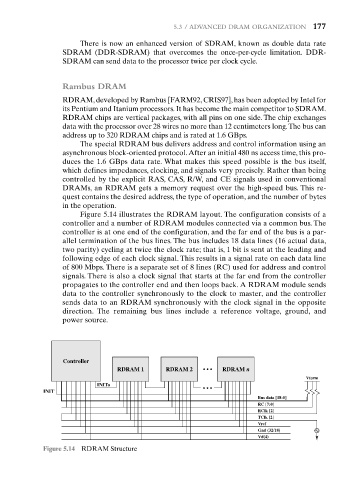
                       Figure 5.14 illustrates the RDRAM layout. The configuration consists of a
                  controller and a number of RDRAM modules connected via a common bus. The
                  controller is at one end of the configuration, and the far end of the bus is a par-
                  allel termination of the bus lines. The bus includes 18 data lines (16 actual data,
                  two parity) cycling at twice the clock rate; that is, 1 bit is sent at the leading and
                  following edge of each clock signal. This results in a signal rate on each data line
                  of 800 Mbps. There is a separate set of 8 lines (RC) used for address and control
                  signals. There is also a clock signal that starts at the far end from the controller
                  propagates to the controller end and then loops back. A RDRAM module sends
                  data to the controller synchronously to the clock to master, and the controller
                  sends data to an RDRAM synchronously with the clock signal in the opposite
                  direction. The remaining bus lines include a reference voltage, ground, and
                  power source.


                  Controller
                                 RDRAM 1      RDRAM 2    • • •  RDRAM n
                                                                                     Vterm
                            INITo
                                                        • • •
             INIT
                                                                       Bus data [18:0]
                                                                       RC [7:0]
                                                                       RClk [2]
                                                                       TClk [2]
                                                                       Vref
                                                                       Gnd (32/18)
                                                                       Vd(4)
             Figure 5.14 RDRAM Structure

