


Page 279 - DSP Integrated Circuits
P. 279
264                                                Chapters DSP Algorithms

            Coefficients c^ are selected such that coefficients d^ are zero for k = I,..., M.
        The maximum sample rate has thereby been increased by a factor M. The corre-
        sponding difference equation is


            The output is computed from the N past values that are clustered in time, i.e.,
        y(n-M-l), y(n-M-2), y(n-M-3),..., y(n-M-N). We illustrate the clustered look-
        ahead pipelining with two examples.


        EXAMPLE 6.11
        Use clustered look-ahead pipelining to increase the maximum sample rate of a
        first-order filter by a factor two.
            The original transfer function is


        We form the new transfer function


        and select c\ = 6^ which yields


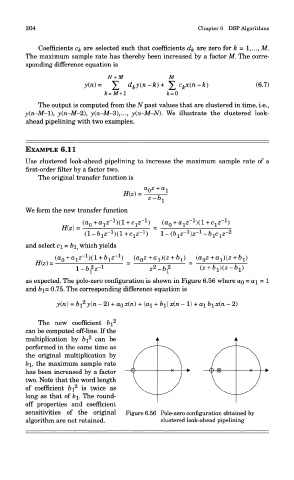
        as expected. The pole-zero configuration is shown in Figure 6.56 where OQ = ai = 1
        and 61= 0.75. The corresponding difference equation is


            The new coefficient 6i 2
        can be computed off-line. If the
                           2
        multiplication by 6j  can be
        performed in the same time as
        the original multiplication by
        &1, the maximum sample rate
        has been increased by a factor
        two. Note that the word length
                       2
        of coefficient &i  is twice as
        long as that of 61. The round-
        off properties and coefficient
        sensitivities of the original  Figure 6.56 Pole-zero configuration obtained by
        algorithm are not retained.             clustered look-ahead pipelining

