


Page 505 - DSP Integrated Circuits
P. 505
490                                            Chapter 11 Processing Elements


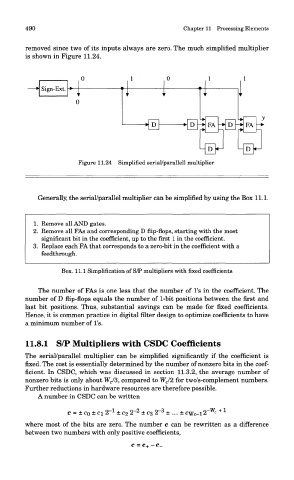
        removed since two of its inputs always are zero. The much simplified multiplier
        is shown in Figure 11.24.


                        Figure 11.24 Simplified serial/parallell multiplier


            Generally, the serial/parallel multiplier can be simplified by using the Box 11.1.


          1. Remove all AND gates.
          2. Remove all FAs and corresponding D flip-flops, starting with the most
             significant bit in the coefficient, up to the first 1 in the coefficient.
          3. Replace each FA that corresponds to a zero-bit in the coefficient with a
             feedthrough.

                   Box. 11.1 Simplification of S/P multipliers with fixed coefficients

            The number of FAs is one less that the number of 1's in the coefficient. The
        number of D flip-flops equals the number of 1-bit positions between the first and
        last bit positions. Thus, substantial savings can be made for fixed coefficients.
        Hence, it is common practice in digital filter design to optimize coefficients to have
        a minimum number of 1's.


        11.8.1 S/P Multipliers with CSDC Coefficients
        The serial/parallel multiplier can be simplified significantly if the coefficient is
        fixed. The cost is essentially determined by the number of nonzero bits in the coef-
        ficient. In CSDC, which was discussed in section 11.3.2, the average number of
        nonzero bits is only about W c/3, compared to W c/2 for two's-complement numbers.
        Further reductions in hardware resources are therefore possible.
            A number in CSDC can be written


        where most of the bits are zero. The number c can be rewritten as a difference
        between two numbers with only positive coefficients,

