


Page 527 - DSP Integrated Circuits
P. 527
512                                           Chapter 11 Processing Elements


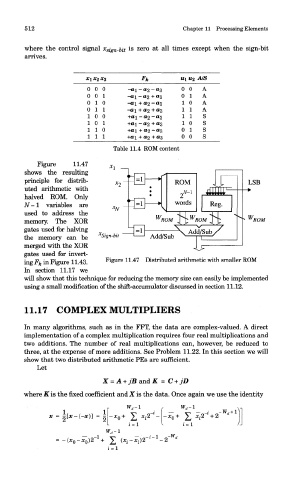
        where the control signal x sig n.i)H is zero at all times except when the sign-bit
        arrives.


                                                      «1 « 2 A/S
                                          F k
                          X\ X 2 X 3
                          0 0 0       -01 -o 2  -03   0 0   A
                          0 0 1       -01 -o 2  + 03  0 1   A
                          0 1 0       -01 + 02 -03    1 0   A
                          0 1 1       -01 + 02 + 03   1 1   A
                          1 0 0       +01 -o 2 -03    1 1   S
                          1 0 1       +01 -o 2 + 03   1 0   S
                          1 1 0       +01 + 02 -03    0 1   s
                          1 1 1       +01 + 02 + 03   0 0   s
                                  Table 11.4 ROM content

           Figure     11.47
        shows the resulting
        principle for distrib-
        uted arithmetic with
       halved ROM. Only
       N-l variables are
        used to address the
        memory. The XOR                                                    ROM
       gates used for halving
       the memory can be      ^Sign-bit
       merged with the XOR
       gates used for invert-
       ing F& in Figure 11.43.  Figure 11.47 Distributed arithmetic with smaller ROM
        In section 11.17 we
       will show that this technique for reducing the memory size can easily be implemented
        using a small modification of the shift-accumulator discussed in section 11.12.


        11.17 COMPLEX MULTIPLIERS

        In many algorithms, such as in the FFT, the data are complex-valued. A direct
       implementation of a complex multiplication requires four real multiplications and
       two additions. The number of real multiplications can, however, be reduced to
       three, at the expense of more additions. See Problem 11.22. In this section we will
        show that two distributed arithmetic PEs are sufficient.
           Let

                               X = A + JB and K = C + jD
       where K is the fixed coefficient and X is the data. Once again we use the identity

               .-&      <-*>] = 2


                                           ,-i-i_ 2-^
                                ; = i

