


Page 147 - Determinants and Their Applications in Mathematical Physics
P. 147
132   4. Particular Determinants

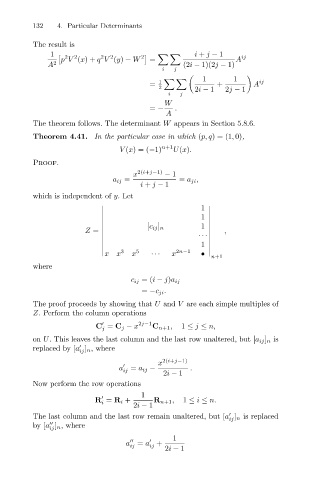
          The result is
                                                    i + j − 1
              1    2  2    2  2       2
                 p V (x)+ q V (y) − W   =                      A ij
              A 2                                (2i − 1)(2j − 1)
                                            i  j

                                                      1       1
                                        =  1              +         A ij
                                           2        2i − 1  2j − 1
                                             i  j
                                            W
                                        = −    .
                                             A
          The theorem follows. The determinant W appears in Section 5.8.6.
          Theorem 4.41. In the particular case in which (p, q)=(1, 0),
                                V (x)=(−1) n+1 U(x).
          Proof.
                                    x 2(i+j−1)  − 1
                               a ij =           = a ji ,
                                      i + j − 1
          which is independent of y. Let

                                                      1

                                                      1

                                                            ,
                                        [c ij ] n     1
                       Z =

                                                     ···

                                                      1
                             xx     x    ···  x       •
                                 3   5         2n−1
                                                         n+1
          where
                                   c ij =(i − j)a ij
                                      = −c ji .
          The proof proceeds by showing that U and V are each simple multiples of
          Z. Perform the column operations

                          C = C j − x 2j−1 C n+1 ,  1 ≤ j ≤ n,
                            j
          on U. This leaves the last column and the last row unaltered, but [a ij ] n is
          replaced by [a ] n , where

                      ij
                                           x 2(i+j−1)

                                a = a ij −         .
                                            2i − 1
                                 ij
          Now perform the row operations
                                      1
                          R = R i +      R n+1 ,  1 ≤ i ≤ n.

                                    2i − 1
                            i
          The last column and the last row remain unaltered, but [a ] n is replaced

                                                             ij
          by [a ] n , where

              ij
                                              1
                                  a = a +


                                            2i − 1
                                   ij   ij

